September 15, 2014
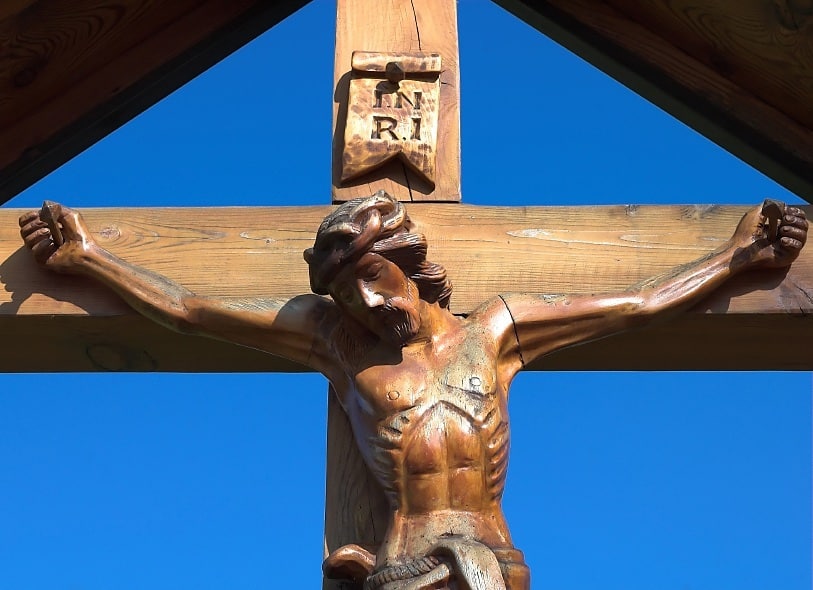
Today the Church joyfully celebrates the great Feast of the Exaltation of the Holy Cross.
Not surprisingly, today’s celebration originated in Jerusalem itself. After the Emperor Constantine legalized Christianity in 313, it became desirable to excavate and build churches on the actual Jerusalem sites traditionally associated with the events of Christ’s passion, death and resurrection. Eventually, Constantine constructed a great Basilica encompassing the entire area associated traditionally with both the hill of the crucifixion and the nearby tomb where Jesus had been buried and which was therefore seen as the site of his resurrection. The original basilica was consecrated on Sept. 13, 335. On the following day, September 14, the relic of the True Cross, which had been discovered by Constantine’s mother, the Empress St. Helena, was solemnly venerated. (The basilica was destroyed by the Persians in 614, destroyed again in 1009, and rebuilt by the Crusaders. The present Basilica of the Holy Sepulcher, which includes both the original holy sites of the Crucifixion and of the Tomb of Christ, was dedicated in 1149.)
With the passage of time, two different feasts in honor of the Holy Cross came to be celebrated in the Church’s calendar – on May 3, the feast of the Finding of the Holy Cross by St. Helena, and on the Sept.14 feast of the Exaltation of the Holy Cross, which commemorated not only the anniversary of the dedication of the original basilica but also the recovery of the True Cross from the Persians by the Byzantine Roman Emperor Heraclius II in 629. Our modern Roman calendar commemorates all these events in the one feast of the Exaltation of the Holy Cross, which we continue to celebrate on Sept. 14.
The Roman Basilica of the Holy Cross in Jerusalem, which is one of the “Seven Pilgrimage Churches” of Rome, was built to house the relics that were brought back to Rome by St. Helena. It was built originally around a room in St. Helena’s Sessorian Palace, which she had adapted as a chapel.
The basilica’s floor was covered with soil from Jerusalem, hence the title “in Jerusalem.” In the traditional Roman calendar, the Basilica of the Holy Cross in Jerusalem is the pope’s “stational church” for the fourth Sunday of Lent, when the Mass begins with the words Laetare, Jerusalem (“Rejoice, Jerusalem”), and on Good Friday. Until recent times, it was where the pope would go on Good Friday for the solemn Veneration of the Cross.
Of course, today’s feast celebrates more than a series of historical events surrounding the relics of the Cross and the shrines associated with it. Fundamentally, the feast celebrates the Cross of Christ as the means and instrument of our salvation.
Thus, the Church prays in the Preface of today’s Mass: “For you placed the salvation of the human race on the wood of the Cross, so that, where death arose, life might again spring forth and the evil one, who conquered on a tree, might likewise on a tree be conquered, through Christ our Lord.”