September 11, 2014
The following is a homily for the Scripture readings for Sunday, Sept. 14, the Feast of the Triumph of the Cross.
Ever since the start of the 17th century, our ability to see small things has been growing. Of course, Galileo gave us the telescope, but he also had a hand in building a microscope, a project that Dutch lensmakers seem to have perfected. A man named Antoine van Leeuwenhoek helped doctors understand what power a microscope can bring to medicine. Then x-rays. Then MRI’s. Then electronic telescopes. Then the amazing technologies we have to examine almost every part of the body.
If we can see it, we think, maybe we can fix it. We see blue or yellow snake-like images of the Ebola virus; it’s right there, in front of us. Surely we can kill it, we think. We have machines that can read out our genes, telling us what the tiniest elements of our bodies are like. With that information, maybe we can re-arrange what’s wrong with us and make it better. If we can see it, maybe we can fix it?
But how do you see the human soul? How do we examine the human heart? We have sociologists and psychologists who can ask questions and often pick up trends going on inside a life or a culture. But can we look into – not my mind or my soul – but the human soul itself?
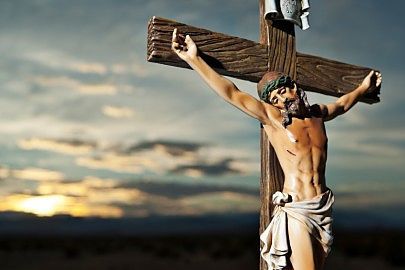
The feast we have today, the Triumph of the Cross, give us an instrument through which much of the human soul can be seen. At first glance, it is not pretty. The death of Jesus points precisely to the lesion that is woven throughout humankind’s spirit: our inability to accept the goodness and love that is offered. In its place, we often resort to rejection and violence. In the cross, we see what people did to Jesus, both from political and social angles – the innocent one who comes proclaiming a new realm of love, now treated like garbage, humiliated to the point of total shaming, an object of torture and scorn.
Surely special circumstances wove their way through that terrible moment in history. But we all know that the anger, the envy, the betrayal, the fear, the violence, the rage – these have all coursed through us at one point or another. When we look at the cross, where Jesus emptied himself of everything in love, as St. Paul puts it, we surely see a part of ourselves.
In the first reading, the Jewish people are saved by looking on the image of a bronze snake. Scholars do not know what historical event this story points to, but the Gospel invites us to look on Christ, on his cross, for our healing, just as ancient Israel looked on the bronze seraph. To let the cross be a microscope to help diagnose the sickness in our hearts. But to let it be, as well, a remedy.
For, beyond our violence and envy, our cruelty and weakness, the cross also shows us something else: in the dying Jesus, we have the gift of God’s love given to us. “God so loved the world that he gave his Son” – to the world, to the Church, but also to me. Jesus, God’s love made flesh, is a gift given to me. If I can receive this gift, maybe I can find an antidote. Maybe the ways of Christ can cure my soul; maybe the blood of Christ can absorb the disease of my sin – of our sin – and transform it into divine love. Come, look on the cross, and see what it tells us, and what medicine it gives us, what hope it promises.
I was one of the few people – to judge from the audience size – to see Calvary. It’s a gripping move, and certainly not family entertainment. But the priest, surround as he is by the doubts and debunkings, by the postures and denials, of modern life, stands tall. Through the haze of post-modern doubt we see, so often, in this film religious images that seem to hold everything together – the Bible, prayer book, holy water fountain, candles, altars, and, most of all the cross. The movie is, ultimately, about hope, about the triumph of the cross even in today’s cynical rejection of belief, a triumph of faith over a deadening doubt.
If we can see, maybe we can find healing. If we can look upon the cross more openly, what wholeness can it bring to our lives?