September 24, 2012
Pope Benedict XVI has declared a Year of Faith that starts with the Synod for the New Evangelization beginning Oct. 7 in Rome. With evangelization as the crux of Paulist ministry, Paulist.org is presenting a series on how evangelization is crucial to every part of the Paulist charism.
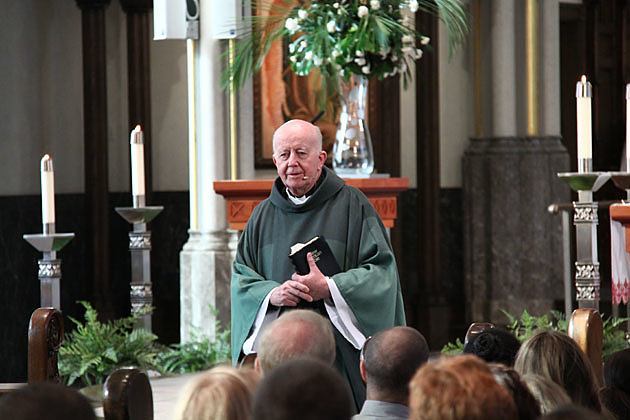
In this Q&A, Father John Geaney, CSP, rector of the Cathedral of St. Andrew and director of the Catholic Information Center in Grand Rapids, Mich., presents the Paulist take on evangelization and its importance to Paulist ministry.
What is Catholic evangelization?
Paulists define evangelization a little differently as reaching out to people who are not Catholic but also those who are Catholic but not engaged in their faith. [Paulist Founder Father Isaac T] Hecker always wanted us to focus on bringing together the Catholic Church and the American people. It’s all about reaching out to people who don’t know Jesus Christ and how a relationship with Jesus brings them to a relationship with God.
How does the synod help place a spotlight on evangelization?
The fact that there is a synod on evangelization speaks of its significance and brings a new energy and focus to this aspect of the Church. But this is a synod on the new evangelization, which is also an interior evangelization. Catholics must be converted in their own hearts and understand the need for Jesus Christ in their lives. This is a chance to focus on our interior lives as well as our life as a church. As Paulists we embrace that. But we also embrace the need to reach out to those who have no faith, or have abandoned their Catholic faith, and bring to them the Good News that Jesus preached and that we continue to preach today.
What will be the measure of success for the synod?
All synods are successful in that they produce documents and awareness on a specific aspect of the Church. In this case we become more aware of the need to evangelize – as individuals and as a church. When we say “Go forth …” at the end of the Mass, it is not merely just a, “Have a wonderful day” statement. It is to remind us to take the Word of God, to take the message of God’s love and concern for us to others. If people are made aware of the need for evangelization, the synod is a success.
Still have questions? Here are some answers from United States Conference of Catholic Bishops website.
What is the Year of Faith?
At certain times in the history of the Church, popes have called upon the faithful to dedicate themselves to deepening their understanding of a particular aspect of the faith. In 1967, Pope Paul VI announced a Year of Faith commemorating the 19th centenary of the martyrdom of Ss. Peter and Paul. The 1967 Year of Faith called upon the Church to recall the supreme act of witness by these two saints so that their martyrdom might inspire the present day Church to collectively and individually make a sincere profession of faith.
The upcoming Year of Faith declared by Pope Benedict XVI is a “summons to an authentic and renewed conversion to the Lord, the One Savior of the world” (Porta fidei 6). In other words, the Year of Faith is an opportunity for Catholics to experience a conversion – to turn back to Jesus and enter into a deeper relationship with him. The pope has described this conversion as opening the “door of faith” (see Acts 14:27). The “door of faith” is opened at one’s baptism, but during this year Catholics are called to open it again, walk through it and rediscover and renew their relationship with Christ and his Church.
Why is the Year of Faith this year?
With his Apostolic Letter of Oct. 11, 2011, Porta fidei, Pope Benedict XVI declared that the Year of Faith will begin on Oct. 11, 2012 and conclude on Nov. 24, 2013. Oct. 11, the first day of the Year of Faith, is the fiftieth anniversary of the opening of the Second Vatican Council (Vatican II) and also the twentieth anniversary of the Catechism of the Catholic Church. During the Year of Faith, Catholics are asked to study and reflect on the documents of Vatican II and the catechism so that they may deepen their knowledge of the faith.
The Year of Faith begins in October 2012 with a Synod on New Evangelization. What is a synod?
A synod of bishops is a gathering of bishops, selected from different areas of the world, who meet with the pope to discuss questions pertaining to the activity of the Church in the world. This meeting of bishops helps to foster a closer unity between the bishops and the pope, and provides counsel to the pope. Pope Benedict XVI has situated the Synod on the New Evangelization (Oct. 7-28) at the beginning of the Year of Faith (Oct. 11).
How are Year of Faith and New Evangelization linked?
The New Evangelization is a call to each Catholic to deepen his or her own faith, have confidence in the Gospel, and possess a willingness to share the Gospel. The New Evangelization is first and foremost a personal encounter with Jesus Christ; it is an invitation to deepen one’s relationship with Christ. It is also a call to each person to share his or her faith with others. The Year of Faith, just like the New Evangelization, calls Catholics to conversion in order to deepen their relationship with Christ and to share it with others.
What is the New Evangelization?
The New Evangelization calls each of us to deepen our faith, believe in the Gospel message and go forth to proclaim the Gospel. The focus of the New Evangelization calls all Catholics to be evangelized and then go forth to evangelize. In a special way, the New Evangelization is focused on ‘re-proposing’ the Gospel to those who have experienced a crisis of faith. Pope Benedict XVI called for the re-proposing of the Gospel “to those regions awaiting the first evangelization and to those regions where the roots of Christianity are deep but who have experienced a serious crisis of faith due to secularization.” The New Evangelization invites each Catholic to renew their relationship with Jesus Christ and his Church. The New Evangelization offers hope.
Why do we need the New Evangelization?
The New Evangelization offers hope. Jesus grants all people rest and comfort from the world’s burdens (Matthew 11:28) by offering us the hope of salvation and eternal life. Through the “re-proposing” of the Gospel, the Church seeks to comfort all those who are burdened. The New Evangelization offers the gifts of faith, hope, love and new life in Christ.
What about the New Evangelization in the United States?
The Church in the United States can be likened to the mustard seed. The Church has been present in the Americas since the first missionaries arrived in the 15th Century. Over the past five centuries, the Church’s foundation has sprung up and taken root in the U.S., spreading her branches and offering shade to the weary. This can be seen simply by looking at the work of Catholic Charities on behalf of the poor, the network of Catholic schools offering education to millions, and the commitment of U.S. Catholics to the Church’s social justice teachings. However, there is still work to do.
The 2008 Center for Applied Research in the Apostolate (CARA) study Sacraments Today: Belief and Practice Among U.S. Catholics … provides a glimpse into the beliefs, practices and attitudes of U.S. Catholics. According to the study, only 23 percent of U.S. Catholics regularly attend Mass once a week, while 77 percent self-identify as proud to be Catholic. These statistics point to the need for the New Evangelization.
The seed of the Church is present, but the message of Jesus Christ needs to be re-sown and watered for those who have already heard Christ’s call, but who have not been fully evangelized or catechized. Truly, the seed of Christ’s message has taken root and yielded much fruit in past seasons. In the spirit of the New Evangelization, it is our hope that the resources on this page will yield even greater harvests for Christ in the future so that all people can dwell in the shade.
For more information, visit usccb.org.