
May 27, 2012
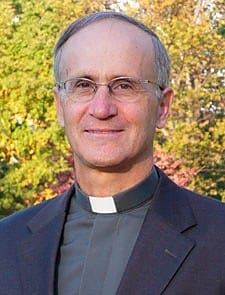 Father Thomas Ryan, C.S.P.
The Holy Spirit comes in for special attention during preparation for confirmation and on the feast of Pentecost, but beyond that, how conscious are we of the Spirit’s activity in our lives and world?
Statements by theologians from various churches would seem to indicate “not much”: “The Spirit among Catholics is faceless, somehow shadowy” (Walter Kasper). “The Spirit is a vague something or other” (Georgia Harkness). “Of all three divine persons, the Spirit is the most anonymous” (Norman Pittenger). “The Spirit is the half-known God” (Yves Congar).
And yet, if as we proclaim in the Nicene Creed, the Spirit is “the Lord and Giver of Life,” then opportunities for encountering the Holy Spirit are as broad as the world itself. We encounter the Spirit in nature, in the personal world and especially in love relationships, and we encounter the Spirit in the social world – economic, political, cultural.
The Spirit, as the biblical prophets proclaimed so eloquently, is especially present and active whenever the poor are mistreated, when violence breaks out, when the widow and the orphan are oppressed. We encounter the Spirit here when we join hands to resist these evils and do the work of justice and peace.
The words we use to speak about the Trinity are but pointers to divine mystery; many of them, not surprisingly, are analogies, images, and metaphors. The second-century theologian Tertullian used metaphors of the natural world to speak about God. One was that of a river which has its source (Father) and flows outward (Christ) and irrigates land to bring forth vegetation (Spirit).
He also uses the metaphor of a plant with its parts of a hidden root (Father), the shoot coming out of the ground and into the world (Christ), and the plant itself bringing forth leaves, fruits, and seeds (the Spirit). Both these analogies point to the Spirit as the one who produces the final, fruitful effect.
And what, in the big picture, is that final, fruitful effect? The redemption of all creation and the salvation of humankind. The second century church father Irenaeus wrote about God being at work in the world from the beginning of time with two hands – the Word and the Spirit. Both hands are working in tandem with each other, and at one point the Word becomes flesh in Jesus of Nazareth who, at the end of his human life, gives us an Advocate, the Holy Spirit, who will teach us everything (John 14:26).
In writing about the sweep of these “two hands” at work in the world, Irenaeaus distinguished four successive periods in the history of salvation, each one corresponding to a divine covenant. First, the covenant with humanity in Adam and Eve. Second, the covenant with Noah, who symbolizes the religious traditions of the nations. Third, the Abrahamic and Mosaic covenant with Israel. And finally, the covenant established by God in Jesus Christ.
The covenants stand to each other as so many ways of divine engagement with humankind through the Word and the Spirit. The covenant with Noah constitutes the lasting foundation for the salvation of every human person. In its entirety, it appears as an outline of the covenants with Abraham and Moses. Israel and the nations thus have a common base: they are in covenantship with the true God and under the same salvific will of that one God.
The covenant with Noah thus assumes a far-reaching significance for a theology of the religious traditions of peoples belonging to the “extrabiblical traditions.” Because they too are covenant peoples, they deserve to be called “peoples of God.”
Vatican II acknowledged that in ways known to God’s own self, God can lead to faith those who, through no fault of their own, are ignorant of the Gospel (Ad Gentes, 7). This happens through the universal working of the Spirit of God: “Christ died for all and since all human beings are in fact called to one and the same destiny, which is divine, we must hold that the Holy Spirit offers to all the possibility of being associated, in a way known to God, with the Paschal Mystery” (Gaudium et Spes 22).
The Church’s Spirit-guided mission is to share the fullness of the divine life which God has destined for all by incorporation in Christ and becoming one People of God.
Father Thomas Ryan, CSP, directs the Paulist North American Office for Ecumenical and Interfaith Relations in Washington, D.C.