April 6, 2009
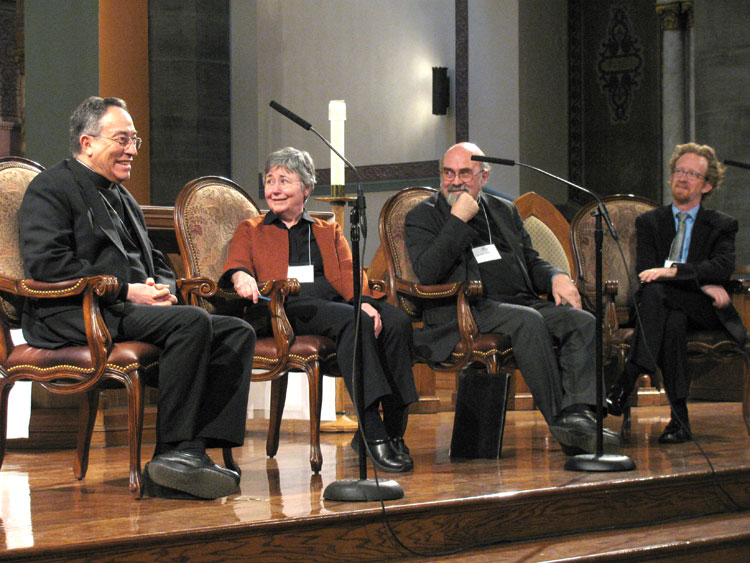
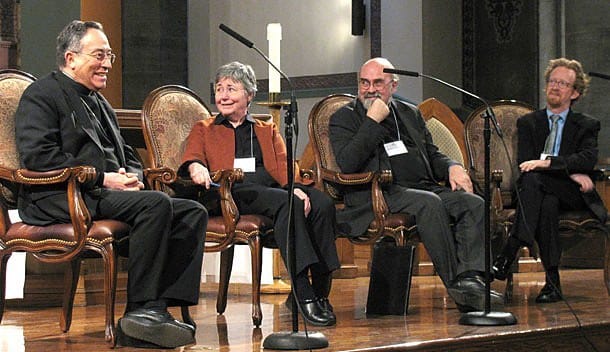 LAUNCH SLIDESHOW | The speakers at the 25th Anniversary Symposium of the National Pastoral Life Center were Cardinal Oscar Andres Rodriguez Maradiaga of Honduras (left); Margaret O’Brien Steinfels, founding director of the Center on Religion and Culture of Fordham University; Father Robert Schreiter, C.PP.S., expert in the areas of inculturartion and the world mission of the church; and Dr. Thomas M. Beaudoin, associate professor of practical theology at Fordham University.
|
In this Holy Year of St. Paul the Apostle, the National Pastoral Life Center examined the legacy of the revered saint as well as its founder during its 25 Anniversary Convocation held March 25 at the Church of St. Paul the Apostle in New York.
“We celebrate a legacy passed on to us by the great apostle Paul, who exhorts us to be attentive to the signs of the times which are yearning to break out in the richness of diversity and the wounds of division,” said Paulist Father John E. Hurley, executive director of the NPLC. “… We celebrate a legacy passed on to us by a great New York archdiocesan priest, Monsignor Philip Murnion [NPLC founder] to promote excellence in pastoral leadership not only in New York but across the nation. … Yes, we have much to celebrate, and our future holds great promise.”
Cardinal Oscar Andres Rodriguez Maradiaga of Honduras, president of Caritas Internationalis, opened the symposium attended by more than 250 people with a talk titiled, “St. Paul: A Man of Many Cultures.” The cardinal noted the multifaceted culture in which St. Paul grew up, not unlike ours today.
“In spite the admirable advances in the technical and scientific world, there is a progressive loss of moral, spiritual and transcendental values,” Cardinal Maradiaga said. “This loss has produced in the world a culture highly centered in greed, power, wantonness and the selfishness that is at the root of the startling financial earthquake, already throughout the world and affecting all dimensions of life.”
The religious and cultural pluralism of today’s society can be clearly seen in the church today,” he continued. “There are other sources and ideas which compete with the church, weakening and making relative its social repercussion and its pastoral action. Not all Catholics are prepared to withstand the multiplicity of ideas and practices present in today’s society.”
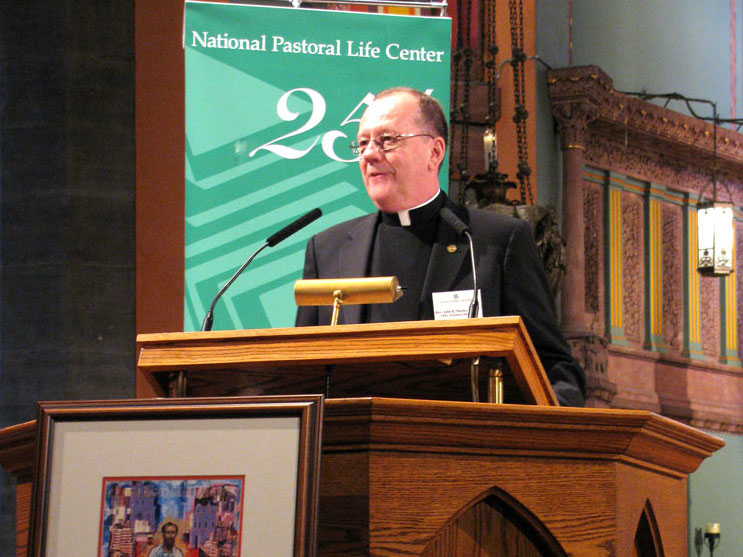 Paulist Father John E. Hurley, executive director of the National Pastoral Life Center, welcomes more than 250 people to the organization’s 25th anniversary symposium held at the Church of St. Paul the Apostle in New York March 26.
The cardinal concluded; “Since he was Hebrew son of a Hebrew: “a pure-blooded Jew” (Phil. 3:5), he profoundly knew the culture, the faith and the traditions of his people. But also knew and recognized the cultural value of the non-Jews, among whom he lived since birth. He communicated orally and by writing in the international language of the time: Greek. Being knowledgeable of the ways for developing relationships in his society, he discovers in it extraordinary strength for telling the Good News. In fact, after observing how communications worked between cities, the good mail system established by the Roman Empire, he copies the ideas and transforms them in an instrument for evangelizing.” [Read full text of Cardinal Maradiaga’s talk]
Father Robert Schreiter, C.PP.S, an internationally-recognized expert in the areas of inculturation and the world mission of the church, explored one of the focal points of the Paulist charism in his talk, “Ambassadors for Christ’s Sake: St. Paul’s Vision of Reconciliation.”
“As the exegete Ralph Martin noted nearly three decades ago, ‘reconciliation’ in some ways sums up the meaning of the Gospel of Jesus Christ for St. Paul, especially as the Gospel message to the Gentiles,” said Father Schreiter.
“Paul’s Gospel of reconciliation is based on an experience of utter graciousness and gratuity coming from God,” he continued. “It is not something achieved by human beings, nor merited by their actions. Thus it cannot be measured completely in human terms. Consequently it is not to be understood as an adjustment of existing systems and relationships; it is, rather, a “new creation” (2 Cor. 5:17). It affects all levels of relationships and systems: personal, communal and cosmic. This reconciliation is effected through the action of Christ, especially through his action on the cross. The cross stands as a sign of contradiction – foolishness to the Greeks, a stumbling block to the Jews: Christ the wisdom of God and the power of God (cf. 1 Cor. 1:23-24).”
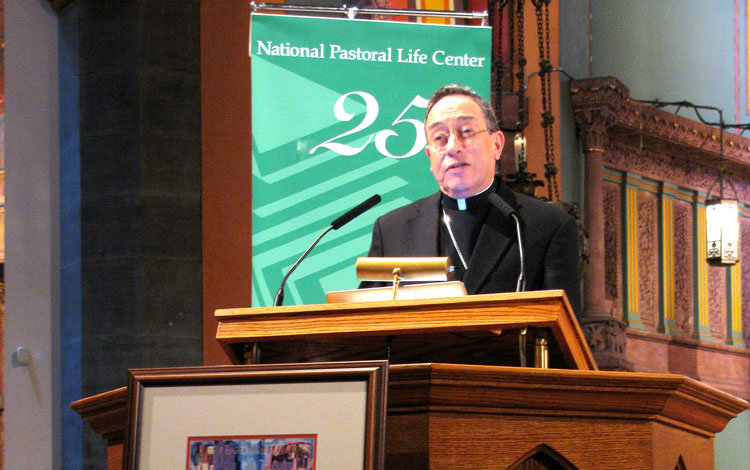 Cardinal Oscar Andres Rodrigues Maradiaga of Honduras gives a talk titiled, “Paul:Man of Many Cultures” at the 25th anniversary symposium of the National Pastoral Life Center March 26.
Father Schreiter continued, “Reconciliation, when all is said and done, is not about technique or strategy but an encounter with a person, and with the mysterious resources of creativity that come with that. … The road to reconciliation is a messy one, something we cannot completely control from our own resources. This constant reminder of the need to de-center ourselves and try to discern the movements of God in what we see and hear helps us keep to our proper roles as agents of God’s reconciliation, as ambassadors of Christ, empowered to speak and act on his behalf, but never being the Christ ourselves.” [Read full text of Father Schreiter’s talk]
Two theologians from Fordham University offered their thoughts on the two talks, and all speakers then took questions from the audience. The respondents were Margaret O’Brien Steinfels, founding co-director of the Center on Religion and Culture at Fordham, and Dr. Thomas M. Beaudoin, associate professor of practical theology.
The symposium concluded with Mass at St. Paul’s followed by a gala dinner and awards presentation in St. Paul’s hall.