March 2, 2020
Perfect for printing: Download this newsletter in PDF format
- A Wilderness Way of the Cross
- Interview with Paulist Father Stuart Wilson-Smith
- Book Review: ASK THE BEASTS: DARWIN AND THE GOD OF LOVE
- Looking for Newsletter Input
- Guidelines/Suggestions on Composing a Program on a Paulist Patron Saint
- Proposed Program for March: Francis de Sales
- Renewing Promises and Updating Lists of Associates
- Paulist Associate News
- Prayer for the Intercession of Father Isaac T. Hecker
- Contacts
- Promise
A Reflection for Lent by Jacqueline Toepfer, Chicago Paulist Associate
(Jacqueline is a Chicago Paulist Associate. She wrote this reflection shortly after visiting the Stations of the Cross at St. Mary’s of the Lake during our National Retreat last summer. We thought it well worth holding it till Lent 2020 for your reflection.)
Nestled into the hillside behind the St. Mary’s of the Lake Chapel at the Paulist Fathers Retreat Home in Lake George, NY, is a wilderness trail which follows the Way of the Cross. While on retreat here in July 2019, I walked the trail several times, and with each walk, I gained greater appreciation for the thoughtfulness of the architect. As I followed along this prayerful trail, I grew to appreciate the hand of a loving artist who had carefully placed each station and verse along the trail, so that I, an observer, could more fully feel God’s presence.
When admiring art, it is often difficult to know what the artist’s intentions were in creating the piece. Did he mean to convey a specific message or create a certain mood? The observer cannot be certain if he or she is correctly interpreting the artist’s intentions. In the same way, I cannot be certain that I have correctly taken from the experience of this wilderness trail all that the architect intended, but I was moved to share my thoughts and observations both to pay homage to a job well done and as a way to explore more fully the impact that this quiet, but powerful, place had on me.
At the start of the trail there is a wonderful verse about wilderness, urging one to enter in to “God’s presence.” The writing is uncredited. Perhaps the author of the verse was also the architect of the trail. The poetic words of the verse suggest that the author has spent time here, for they capture all the beautiful aspects of the mountainside – the creaking of the tall trees, the singing birds, the jagged stones. They also suggest that the author may have come here to be renewed during times when he or she was experiencing a spiritual wilderness. I am reminded that there have been times when I experienced a spiritual wilderness.
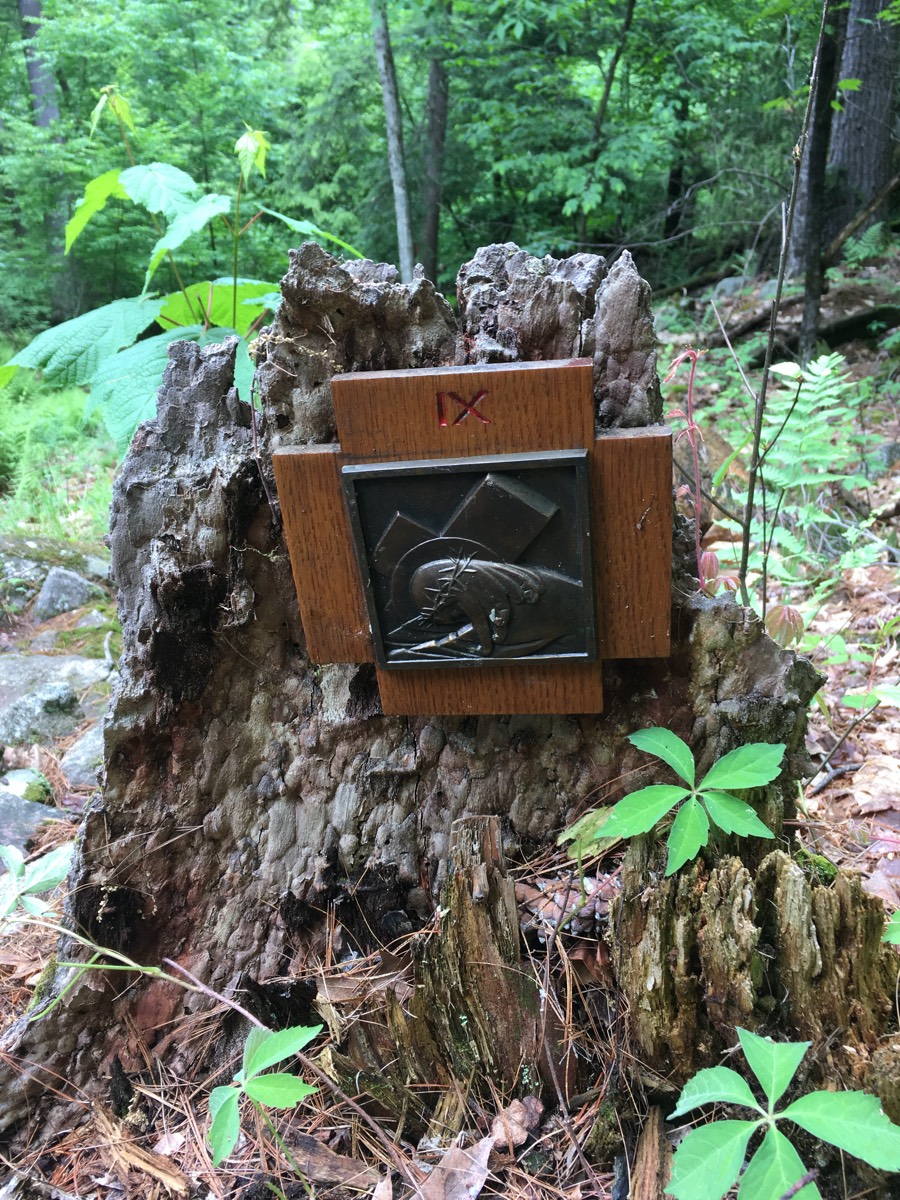 The trail travels up the mountain side as the Stations of the Cross unfold. The path is at first easily walkable, but with each station it grows a bit steeper and more difficult to traverse. One can easily equate this with the escalation of difficulty that Jesus would have experienced as he travelled the road to Calvary.
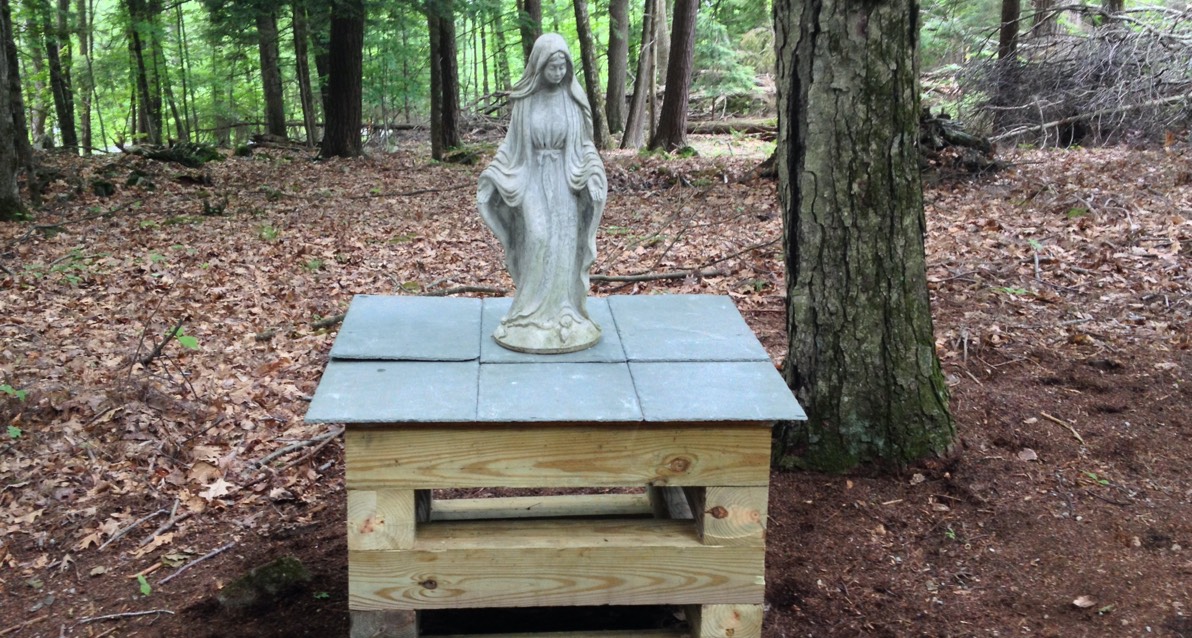
When one reaches the station where Jesus meets his mother, we find not only the placard demarking the station, but also a statue of our Blessed Mother Mary. A small bench invites one to sit and envision a tender moment of familial love. How difficult it must have been for Mary to see her son suffering, and how difficult it must have been for Jesus to know how much his beloved mother was hurting. As a mother, this touches me deeply and brings a tear to my eye.
At the station where Jesus meets the women of Jerusalem, there is a lovely excerpt from Evangelii Gaudium by Pope Francis which acknowledges the contribution of women to both society and to pastoral work. There is a call for broader opportunities for women in the church and our social structures. It is a lovely reminder of how Jesus called women into his ministry and how he saw women as persons of value, treating them with dignity and fairness. As a woman, this invitation for greater inclusion encourages me.
A fallen tree marks the station where Jesus falls for the second time. The station placard is hung on the remaining trunk with its jagged top and the long round trunk of the fallen tree lays on the ground next to it. A striking reminder of both the weight of the cross that Jesus was forced to carry, but also a powerful symbol of the hopelessness that his disciples must have felt as they watched him fall, not knowing if he would be able to get up, and not yet understanding his resurrection. I recognize in this that I too experience times of hopelessness.
Here the path turns more sharply uphill and one encounters tall stone steps. Climbing the steps calls to mind the growing fatigue Jesus would have felt with each passing step as he climbed the hill to his crucifixion. Yet the strong stone steps provide clear direction compared to the preceding trail which, probably because it was more easily traversed, had evidence that many had deviated from the trail. Here, there is no choice but to climb the stone steps. A reminder that the Way of the Cross is difficult, and it takes strength to follow Jesus.
At last you arrive at the station where Christ is crucified. From here the trail will turn downhill, making this the highest part of the trail. A tall tree, to which the station placard is attached, stands at the apex, mirroring the cross on which Jesus would hang. On the ground next to the tree is a large log, which lies perpendicular to the tree. The setting is striking. I can easily visualize our Lord’s hands laying on the log, as nails are driven into his wrists, and the coming moment when his body will be lifted to hang from the tree.
Along the path, there are crucifixes at most of the stations. They are simple wooden crosses, bare of any image of the Lord Jesus. But when one arrives at station XII, Jesus Dies on the Cross, there is at last a cross which bears the image of the crucified Christ. It is striking in that the figure of Christ, while fashioned out of metal, appears to be limp. It is easy to imagine the limp, lifeless body of Christ hanging on the cross. The isolation of this sole image of Christ on the cross, heightens the impact, and the despair of that moment seems very real.
At this point, one encounters a Thomas Merton prayer, which perfectly captures the uncertainty Jesus’ followers must have experienced at that moment. Where should we go? What should we do? I am reminded of times when I faced uncertainty and was looking for direction, and this prayer, one I often turn to, provided comfort knowing God would lead me.
The station placard for the burial of Jesus is placed inside a triangle of trees, which creates the effect of a tomb. A nearby sculpture made of stones recalls the stone which was rolled in front of the tomb. But the position of this sculpture, a comfortable distance away from the triangular tomb, perhaps provides a hint that the stone would soon be rolled away and provides a glimmer of hope.
Immediately after this station, one encounters a verse which speaks of the increased action of the Holy Spirit, a reminder of the resurrection and ascension of Jesus and the gift of the Holy Spirit. A message of hope after the stirring reminder of the suffering of Jesus who was buried in the tomb.
There could be no more fitting end to the trail than the following verse by Pope Francis from Laudato Si, posted just before one arrives at St. Mary’s of the Lake chapel, and I feel that the architect has chosen it with deliberate care:
The universe unfolds in God, who fills it completely. Hence, there is a mystical meaning to be found in a leaf, in a mountain trail, in a dewdrop, in a poor person’s face. The ideal is not only to pass from the exterior into the interior to discover the action of God in the soul, but also to discover God in all things.
Arriving at last at the chapel, one can step inside for prayer and reflection, but for this observer, the walls of the chapel have become superfluous. It is not necessary to go into the chapel to feel God’s presence. God is present for me on that mountain side and, through the work of the trail architect’s hand, God’s presence has been made powerful and real. But I enter the chapel anyway to thank God for the beauty of this setting, the opportunity to be here in this peaceful place, and for the architect, whose skilful and loving creation reminds me to recognize God’s presence in all things.
Levita Anderson – Old St. Mary’s Chicago Paulist Associate
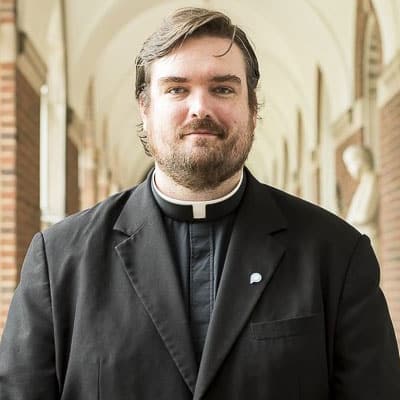 On July 21, 2019, we welcomed our new associate pastor, Father Stuart Wilson-Smith.
Father Stuart is a Canadian from Fredericton, New Brunswick who is a songwriter and has released two albums. His second album is “It’s Not Just You, Its Everybody.” Father Stuart was ordained a priest on May 20, 2019 and was a campus minister at Ohio State University from July 2017 thru July 1, 2019. The “fire” that Father Stuart has is very evident in the interview we had. It was an extreme pleasure to interview a very spiritual and dynamic young man.
How has your tenure so far been as an Associate Pastor of Old St. Mary’s Church?
I’ve been very blessed. The hospitality and welcome I’ve received has made me feel blessed and happy. I don’t feel like a newbie. Adjusting to apartment living after living in a house in a smaller city has been a relearning experience, but the routine of prayers, meals, and being with other Paulists has helped me adjust. The weather so far doesn’t feel as cold as I’d been prepared for. I asked him why? I grew up on the east coast of Canada, and the winters were…brisk.
What expectations do you have for the parish and yourself?
I have much to learn from the community especially in this first year. I want to be present to the spirit of the parish and absorb everything the community has to offer. I’d also like to get a sense of how the Paulists, and our charisms are lived out here.
My expectation for myself is to learn and be receptive to the Spirit. While I may have some hopes and ideas, I think getting to know the community, its past and present, is priority number one.
What obstacles, if any, do you wish to overcome?
One obstacle I want to avoid is complacency in my ministry. I want to be an open, reflective, listener to the Spirit. Like Fr. Hecker, I go into ministry assuming the Spirit is about some work, and my aim is to be attuned to that, and to do my small part.
What experiences are you bringing to the parish that will help us to continue to grow physically and spiritually?
I suppose I bring a pretty wide variety of experience that are an extension of my Paulist experiences as a seminarian and deacon. Working in a hospital in clinical pastoral work where I worked with individuals and families with various spiritual and physical needs.
At the Ohio State University, working with students of various points in their faith lives, and taking on the bigger questions they brought forth about vocation, meaning, the Church, much else. I have been able to do a lot of different things, but it has all been the same Spirit at work, bringing people closer to the same person of Jesus.
But the variety of ministry a Paulist can partake in throughout formation and beyond is a great aspect of formation. You see how the work of the Church happens with varying levels of resources and organization, and with a diversity of liturgical expressions too.
While working as a Paulist student and deacon at St. Matthew Cathedral in Washington DC, there was a calendar, staff members dedicated to areas of ministry, and a budget. Other places ran more off what ministry participants would offer, and most meetings may happen more informally in the same couple of rooms. From these experiences, I learned that instead of stressing over what I can’t change or trying to make everything fit the same mold, I just “go with the flow” and only add my input where necessary. It’s not that I don’t have a vision, but if the Holy Spirit can be collaborative, so can I.
In conclusion, is there anything you want to say that wasn’t discussed earlier?
Just to re-emphasis that I do, ultimately, want to be attentive to how the Paulist charisms are alive here at OSM. I love my Paulist vocation and I think it’s important to reflect on those things that make us unique, in service of the wider Church.
The Paulists have committed to be of greater support to LGBTQ people, for instance. What might be supportive here in that area? How can I be more welcoming and conscientious of voices and experiences other than my own? How can I be more attentive to Paulist emphases in general-including reconciliation and ecumenism-in my preaching and talks?
I want to do the things that we do well as Paulists and follow Father Hecker’s vision as best I can. I’d also like to be attentive (and outreach-oriented) to the Young Adults in our midst, as that has been a Paulist focus as well. As I said, I am still just getting to know the community now and working on some of the basics, but I’d like to hoe that down the line I could do a little more experimenting, even if something isn’t right or perfect out of the gate. Pope Francis seems very open to messiness, and so am I. Often it is there, and less in perfect, ideal structures, that the Spirit accomplishes great things.
By Mary Burke, is one of the first Boston Associates (2004) and a retired Suffolk University Professor of Government (Political Science)
 Theologian Elizabeth Johnson’s study of Charles Darwin’s On the Origin of Species and in a 2009 seminar at Fordham University honoring the 150th Anniversary of the publication of the British scientist’s earth-shaking work. Her theological response, Ask the Beasts, published in 2014, a year before the Laudati Si encyclical, challenges readers to reflect that, in considering the original creation and the New Creation to come, Catholic theology is not in conflict with the evidence of science, neither the Big Bang Theory of the universe’s origin nor the multiple ideas of how the earth and universe will end.
Charles Darwin was an unhappy atheist. His observation on his five year trip on The Beagle along the coast of South America (1831-36), his reflections on that trip, and subsequent research led him to conclude that the story of creation found in Genesis, which in Darwin’s day Anglicans held to be the actual story of creation, was wrong. His personal experiences, including the death of his 10-year- old daughter Annie, and the violence he saw in nature led him to reject the idea of a loving God.
Thus, he could write to a friend that though he would wish to see it differently, he could not see beneficence and a grand design in the world. Elizabeth Johnson,while respecting Darwin’s judgment, would have disagreed with him.
Johnson divides her work into three sections: a review of On the Origins of Species a theological reflection on evolution, and some concluding thoughts including a review of the destructive interaction between humans and the rest of creation.
After a brief review of Darwin’s life, Johnson undertakes here a careful look at Origins using the First Edition published 23 years after the trip on the Beagle, as her guide. During this interim, Darwin produced a popular journal of his trip, and conducted the further research and study needed to develop his theory. His home, a farm in Kent, was itself the site of a number of these studies. Over the years, for example, he carefully studied a section of the bank lining the road to the farm. When he finally published his theory — all species changed by small modifications that became permanent because they furthered the life of that species in that place — Darwin began with the experiences known to his neighbors. Farmers traditionally saved seeds and bred animals to increase a desired characteristic. Then he introduced data from his trip and examples of other changes to account for differences found in plants, birds, and other animals in a variety of places and times, including the changes in his patch of roadside bank, “the entangled bank.”
Darwin published six editions of Origins, the last in 1872, ten years before his death. Each new edition was a revision of the previous one, incorporating new scientific advances and answering criticisms of the earlier edition.
He used the term “natural selection” in early editions but not the term “survival of the fittest” until the fifth edition. The term, was taken from Herbert Spencer, a political theorist who promoted the idea of societal winners and losers. The melding of Darwin’s theory and Spencer’s philosophy became the concept of “social Darwinism.”
Though still with some questions, Darwin’s theory, modified and adjusted, is accepted by scientists as the explanation of how the world has evolved.
Johnson begins her theological reflection with a quote from Job, who, in the midst of his distress, challenges his friends to abandon their rigid certitude about how the world works and look to another source of wisdom
Ask the beasts and they will tell you
The hand of God has done this.
In his hand is the life of every
living thing. (Job 12:7.9-10).
Using the Bible as a primary resource, Johnson focuses the major portion of her work upon ongoing creation the second of the three dimensions of creation. She begins by reminding us that humans are just one part of the creation story. Animals of every description are a part of created life as is that “entangled bank.”
How the West came to minimize the non-human aspects of creation has many elements. The influence of Greek Philosophy with its separation of spirit and matter is clearly major. Yet, even as Western theology moved away from attention to creation’s totality, the means of retrieving it remained: the Holy Spirit identified as the “Lord and Giver of Life.”
Johnson emphasizes the life-sustaining presence of God in all of the world. Metaphors used are drawn from nature and philosophy, wind and water. Woven through all is the affirmation that God’s action is the manifestation of God’s love and graciousness, which gifted all creation with freedom and the ability to develop its own natural power. Human freedom has been a given of Christian theology: The God who is Love has enhanced human power to allow us to be co-creators of our well-being.
Johnson explores the history of how theologians have struggled with the concept of human freedom and how to extend it to all creation. Natural law and chance, the latter a gift to all living things, can account for change. God’s loving Spirit has empowered living things and is present in their transition to greater complexity with many different properties.
Early Christians came to conclude that Jesus was the Word of God, the Son of God who had overcome death. He is regarded as being with us through life’s passages, leading us to a New Creation. Since God loves all creation, it follows that God accompanies all sentient creation as it suffers and dies.
In thinking about what the New Creation might be, Johnson points to 20th Century shifts in ideas about Redemption that look to Scripture as in the early days of the Church. Redemption not only freed us from our sins but frees all creation from death and decay. God’s love of creation, she writes, is what sends Jesus into the world to be with all creation as it grows through time, and to redeem it all from death and corruption. Paul, in his letters, also says that all creation is redeemed. His hymn in Colossians (1:15-20), repeats that in one way or another five times.
As she draws her reflection to an end, Johnson pays special attention to a couple of aspects of human evolution, its complexity and its impact. In the 21st Century, these characteristics, corrupted by the selfishness of some of us, are destroying creation: Population growth, resource consumption, and pollution are leading to species extinction at an alarming rate. Once a species is extinct, not only is it gone, but that branch of the tree of life is broken off and the promise of God’s creation is ended.
In the Bible, especially Genesis, the Book of Job, the Psalms and the Prophets, God tells us in different ways that we humans are embedded in creation. We are called to move from androcentric thinking and see ourselves united to all creation.
Johnson urges us to hear God’s call that we co-creators become protectors of a flourishing community that includes the “entangled bank” and the beasts.
Dear Associates,
This month’s issue of Associates World contains two pieces submitted by Associates. We are always anxious to have more.
If you’d like to make a submission, you should send it to Denis Hurley at [email protected]. These are some simple style suggestions that we ask you follow in making submission:
- Articles should in the range of about 600 words.
- They should be typed in (preferably Calibri) some sans serif font in 12 point type.
- Pictures should be accompanied by captions describing where those who are pictured are, what they’re doing, and who they are (full names) in left-to-right order.
- You should add a byline with the form of your named you’d prefer to be identified by.
- You should cite all sources with phrases such as, “according to,” “in Name’s words,” or, best of all, “Name said.” That last one should be in past tense and should not be substituted for with more abstract words such as “feels” or “thinks.” (“Said she feels” or the like is OK, but the writer can only know what the source has said.)
- Please also say something about yourself, as in, ” Boston Associate Denis Hurley is a former newspaper, magazine and broadcast editor. He Is currently a Lecturer at the Boston University College of Communication.”
We love book reviews and descriptions of special events various Associates may have sponsored. And, especially as we approach particular seasons, we’d like to know about any personal reflections you may have. (Some Associates have, for instance, shared thoughts about books they may read or practices they may use during Lent.) And, since many will be following the suggested programs we post each month, it would be interesting to hear some thoughts that have emerged from those discussions in individual groups.
Don’t worry if you’re not sure about a topic. If you’re really concerned, you can send a suggestion and we’ll get in touch with you about it.
And don’t worry about your writing. What you write has to be yours. We can do any editing of specifics that’s necessary.
Thank you. We look forward to hearing from you.
The Editors.
I think we are off to a good start on our monthly proposed programs on our 15 Paulist Patron Saints. I did February’s program on John of the Cross and this March issue is on Francis de Sales by Paulist Mike Martin.
We already have several groups scheduled in the future. The Chicago Associates will be doing St. Joseph for May. Boston will do Mary Magdalene for July; it will appear in the June issue, as there is no Newsletter in July. Columbus is on the calendar with John Henry Newman for October’s issue. The Tucson Associates have committed for Teresa of Avila and Isaac Jogues for months TBA.
There is still time for someone to fill the April program. Anyone? Eight of our Patrons are still in need of a Proposed Monthly Program. Email me at [email protected] to get on the schedule.
You can use Fr Mike Martin and my programs as templates or be creative as long as you follow the guidelines/suggestions below:
- As you compose your program, keep in mind why do you think the Paulists choose this saint to be a patron? How might this saint model and help the Paulists, Paulist Associates, and Paulist Deacon Affiliates live Hecker’s vision and the Paulist mission?
- Have an opening and closing prayer
- you might choose from the prayers in The Paulist Prayer Book in the sections Calendar of Patron Saints and Monthly Patrons and Points of Reflection.
- a brief description and important highlights of the saint’s life
- Some passage(s) by Hecker or other Paulist writings or statements in which the Patron is mentioned, or simply reasons you think this Saint is a Paulist Patron.
- MOST IMPORTANT is the GROUP SHARING section, the purpose of which is to give everyone an opportunity to share. If possible, have some short selections from the saint for everyone to pick and explain their favorites. This, of course, won’t be possible for all the patrons; with those saints compose a question or two in the range of the first bullet. How does the saint, for example, model and inspire you to be a better Paulist Associate?
|
The official list (15) of the Paulist’s heavenly protectors and patrons in order of the Church calendar. The Church year begins the First Sunday of Advent. |
|||
|
December 8 |
The Blessed Immaculate Virgin Mary |
May 26 |
Philip Neri |
|
December 14 |
John of the Cross |
July 22 |
Mary Magdalene |
|
January 4 |
Elizabeth Seton |
August 1 |
Alphonsus Liguori |
|
January 24 |
Francis de Sales |
October 9 |
John Henry Newman |
|
January 25 |
Conversion of St Paul |
October 11 |
John XXIII |
|
January 28 |
Thomas Aquinas |
October 15 |
Teresa of Avila |
|
March 17 |
Patrick |
October 19 |
Isaac Jogues |
|
March 19 |
Joseph, husband of Mary |
|
|
Submitted by Paulist Mike Martin, CSP who is in residence with the Paulists in Vero Beach, FL and helps with our Paulist Associates in Florida.
OPENING PRAYER
Be at Peace. God, whose very own you are, will lead you safely through all things; and when you cannot stand it, God will carry you in His arms. Do not fear what may happen tomorrow; the same understanding Father who cares for you today will take care of you then and every day. (Taken from the writings of Francis De Sales)
Francis de Sales was born in 1567 and lived most of his life in the Kingdom of Savoy, made up of parts of Italy, Switzerland, and France. Of a noble family, he received an excellent education. His father wanted him to become a magistrate but after a few years searching he chose to become a priest. The Protestant Reformation had swept through the region a generation before. The great Cathedral in Geneva had been taken over by Calvinists, as had many parishes. At first, he evangelized. The region would not allow anyone to attend a Catholic sermon, so Francis wrote brief Tracts describing the Catholic faith. He posted them in public areas and slipped them under doors. For several years he was persecuted, reviled, and results were sparse. But within six years 76,000 had returned to the Church, “but a hundred Calvinists remained,” and parishes were renewed. When Francis de Sales became bishop of Geneva he resided in Annecy since Geneva was closed to him. He wrote The Introduction to a Devout Life, which encouraged everyone to holiness, whatever your state in life. It was written specially for laypeople. In it he counseled charity over penance as a means of progressing in the spiritual life. Sales also left the mystical work, the “Treatise on the Love of God“, and many highly valued letters of spiritual direction, including those with Jane Frances de Chantal compiled in the Letters of Spiritual Direction. During his years as bishop, de Sales acquired a reputation as a spellbinding preacher and something of an ascetic. His motto was, “He who preaches with love, preaches effectively.” His goodness, patience and mildness became proverbial. He died on December 28, 1622 and his Memorial as Bishop and Doctor is celebrated on January 24th.
Servant of God and Paulist founder Isaac Thomas Hecker wrote:
We are all willing to give ourselves to God as long as God leaves us alone, our wills untouched. Yet how can the Spirit of Truth lead us into all truth unless we yield and allow it? As Francis de Sales wrote, yielding to God is “the virtue of virtues.” God demands a heroic abandonment of ourselves to His good pleasure. The measure of that abandonment is the measure of our union with God – our progress. It is the delight of God’s tender and parental heart to care for His children, the work of His hands and the price of the blood of his only Son.
The more we trust in God, the more God will trust Himself to us. All that God asks of us is to let him act with full freedom in our regard. All that God wishes is to make us like Himself (infinitely holy and happy).
God would have us forget ourselves; for self- forgetfulness is the beginning of the life of God in the soul. In God the soul places all its hopes and desires. It is converted completely to God. It ignores, the past, present and future. It throws itself without reserve into the arms of God. All that has existence is in God and outside of God there is nothing. Let it cost what it may. Let us throw all care upon God and put all our confidence in him. This is what God wishes of us. What do we have that we have not received by being faithful to God and trusting in His providence? God has not changed His providence towards us.
SHARE WITHIN YOUR GROUP
St. Francis de Sales is quite readable and inspiring. Here are eight brief quotes that outline his gentle approach to the spiritual life. Pick one you like and share what it means to you. If there is enough time, pick a second.
- Amid all our dryness, let us never grow discouraged, but go steadily on, patiently waiting the return of better things.
- Never be in a hurry; do everything quietly and in a calm spirit. Do not lose your inner peace for anything whatsoever, even if your whole world seems upset.
- Half an hour’s meditation each day is essential, except when you are busy. Then a full hour is needed.
- The bee collects honey from flowers in such a way as to do the least damage or destruction to them, and he leaves them whole, undamaged and fresh, just as he found them.
- When you encounter difficulties and contradictions, do not try to break them, but bend them with gentleness and time.
- Retire at various times into the solitude of your own heart, even while outwardly engaged in discussions or transactions with others, and talk to God.
- Be who you are and be that well.
- Have patience with all things, But, first of all with yourself.
CLOSING PRAYER
O God, who for the salvation of souls willed that the Bishop Saint Francis de Sales become all things to all, graciously grant that, following his example, we may always display the gentleness of your charity in the service of our neighbor. Through our Lord Jesus Christ, Amen
We are always happy to hear about new Associates taking promises as well as current Paulists renewing theirs. Please post notices and photos on Facebook and let us know so we can add the information in this newsletter.
When these renewals take place, it would be helpful to all if the local coordinator would send an updated list of Associates to Kathleen Lossau so she can keep our contact list current. Please email contact information for those taking first promises and those renewing promises as well as a list of those who have opted not to renewing promises to Kathleen Lossau <[email protected]>.
The Chicago Paulist Associates at Old St. Mary’s renewed their promises on the Feast of the Conversion of St Paul.
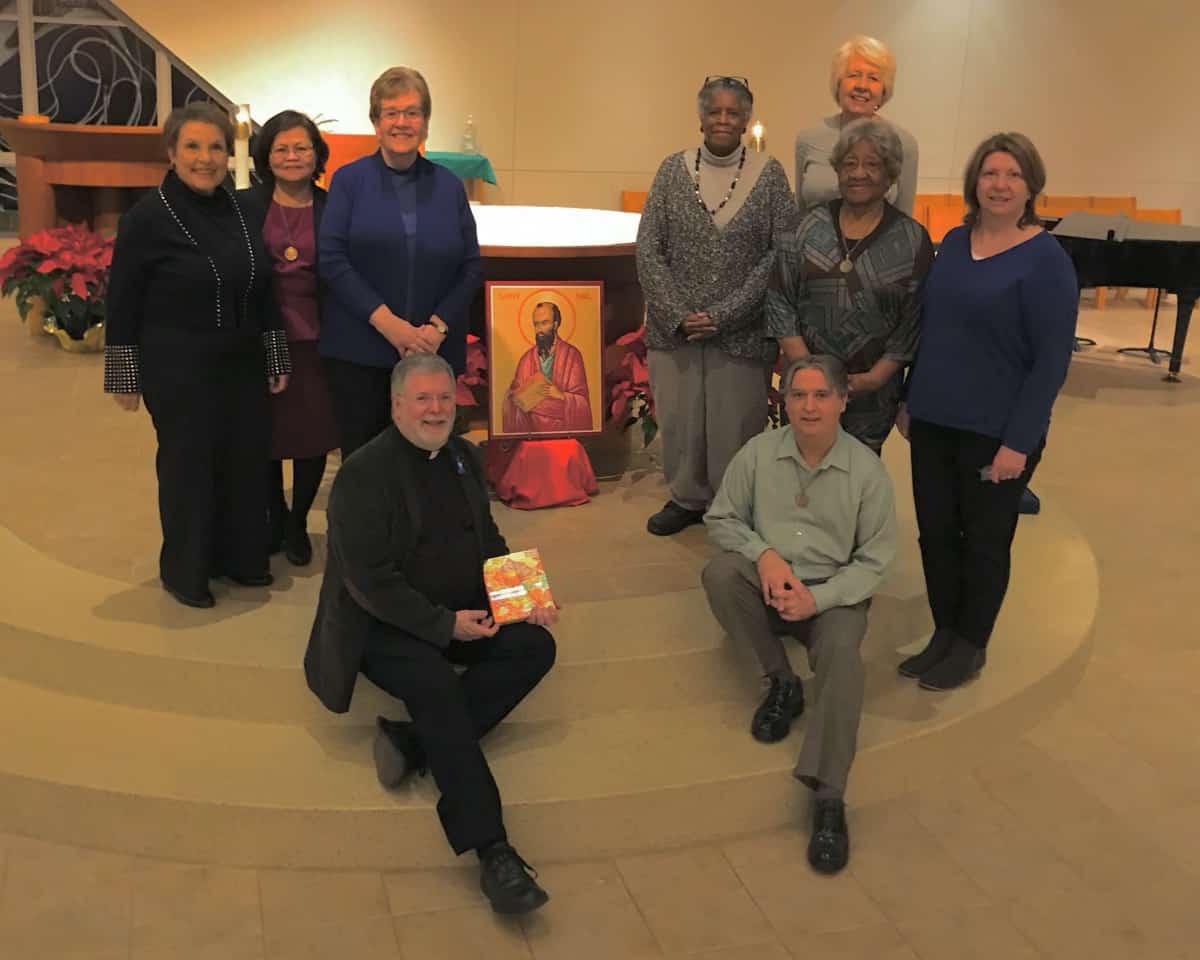
Pictured clockwise from top left: Dorothy O’Malley, Susie Faigao, Jan Newport, Levita Anderson, Maryann Cushing, Betty Kenny, Jacqueline Toepfer, David Rooney, Fr. Brad Schoeberle.
 Heavenly Father, you called your servant Isaac Thomas Hecker to preach the Gospel to the people of North America and through his teaching, to know the peace and the power of your indwelling Spirit. He walked in the footsteps of Saint Paul the Apostle, and like Paul spoke your Word with a zeal for souls and a burning love for all who came to him in need.
Look upon us this day, with compassion and hope. Hear our prayer. We ask that through the intercession of Father Hecker your servant, you might grant us (state the request).
We ask this in the name of Jesus Christ, Your Son, Our Lord, who lives and reigns with You and the Holy Spirit. One God, forever and ever. Amen.
When you pray this prayer, and if you believe that you have received any favors through Hecker’s intercession, please contact the Office of the Cause for Canonization of Servant of God, Isaac Hecker at [email protected]. Visit the web site: isaachecker.org to learn more about his life and the cause for his canonization.
Paulist Associates National Director
Mike Kallock, CSP
Paulist General Office
New York, NY 10023
Board Members
Carol Wagner Williams
Tuscon, AZ
Frank Desiderio, C.S.P.
Katherine Murphy Mertzlufft
Columbus, OH
Joe Scott, CSP
David Rooney
Chicago, IL
Mary Sullivan
Boston, MA
I believe that I am drawn by the Holy Spirit to the spirituality and qualities of the Paulist Community. I have discerned both by prayer and study that God calls me to become associated with the Paulists. I promise that I will pray for the works of the Paulist Society, meet with others, who are also members of the Paulist Associates, for spiritual sharing and formation; and I seek to embody the apostolic qualities of the Paulists in my daily life.
Attentive to the Holy Spirit and faithful to the example of St. Paul and the charism of Father Isaac Hecker, I commit myself for one year of membership in the Paulist Associates.