December 19, 2022
Paulist Fr. Rich Andre preached this homily for the 4th Sunday of Advent (Year A) on December 18, 2022, at the Paulist Center in Boston, MA. The homily is based on the day’s readings: Isaiah 7:10-14; Psalm 24; Romans 1:1-7; and Matthew 1:18-24.
At this time of year, we are naturally drawn to celebrating Mary’s unique role in salvation history. As we await Jesus’ birth, we think of the one who carried him in the nine months before Christmas. Most of what we know about Mary comes from the Gospel of Luke.
While Luke focuses on Mary, Matthew invites us to spend time with Joseph. For three consecutive Sundays, once every three years, we have the opportunity to focus on St. Joseph’s role in salvation history. But since Christmas falls on a Sunday this year, all we get for the next three years is this one weekend!
Joseph has much to share with us. He is the example par excellence of how we can bring holiness to our everyday lives. He has been declared the patron saint of all workers, of Austria, Belgium, China, Korea, and the Philippines, as well as the Western Hemisphere and the universal Church.
Let’s make the most of this weekend before Joseph recedes from our liturgical consciousness again until Christmas of 2025. But first, let us celebrate God’s great gift of mercy.
On Thursday morning, March 19, 1863, at the Church of St. Paul the Apostle in New York City, Isaac Hecker, the founder of the Paulist Fathers, preached his most famous homily. After talking about the many saints we revere from time periods and personal circumstances very different from our own, Hecker proclaimed that St. Joseph was the best saint for our day. Even though it was nearly 160 years ago that he said this, I think he’s still right. And I quote:
St. Joseph… was in the world and found God where he was.
He sanctified his work by carrying God with him into the work-shop…
Our age is not an age of martyrdom, nor an age of hermits,
nor a monastic age.Although it has its martyrs, its recluses, and its monastic communities,
these are not, and are not likely to be,
its prevailing types of Christian perfection.Our age lives in its busy marts, in counting-rooms, in work-shops, in homes,
and in the varied relations that form human society,
and it is into these that sanctity is to be introduced.St. Joseph stands forth as an excellent and unsurpassed model
of this type of perfection.from “The Saint of Our Day,” from Sermons, Preached at the Church of St. Paul the Apostle, New York, During the Year 1863 (New York: Sadlier, 1864).
For rest of Hecker’s life, whenever people asked him about his vision for the Church and for the Paulists, he simply referred them back to this homily on Joseph.
160 years ago, the idea that holiness was to be pursued in the workplace and the home might have sounded surprising. Today, thanks to Vatican II, it doesn’t shock us as much. Nevertheless, the Church has had a complicated relationship with Joseph. People keep trying to make him as different from the rest of us as possible. For example, by the 2nd century, there was a popular tradition claiming that Joseph was a wealthy 90-year-old man who arrived at the temple. His staff suddenly bloomed with lilies, indicating to the rabbis that God wanted Joseph to betroth the 12-year-old Mary.
By today’s standards, such an age gap is wholly inappropriate. This story still influences us more than we acknowledge. If you go to Joseph’s Wikipedia page, here’s the first image you’ll see, from the 17th-century painter Guido Reni:
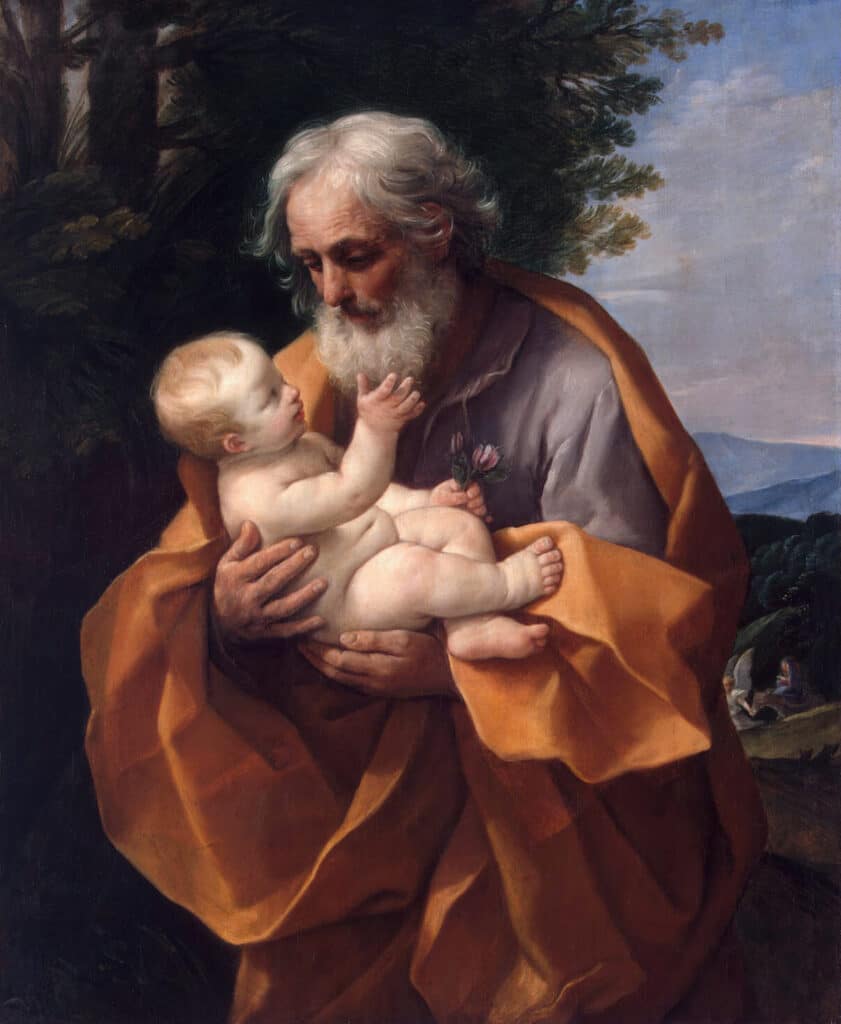
This guy looks old enough to be Jesus’ great-grandfather! Or maybe you’ve seen holy cards similar to this one:
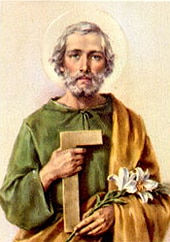
You can argue that this guy is just prematurely grey, but you’ll notice that he’s carrying lilies.
These depictions of Joseph demonstrate a phenomenon we see too often in the Church: a lot of people prefer their saints to be old, white, and celibate. This is not how I imagine Joseph. I envision a young man, half my age, a devout Jew, betrothed to Mary, a woman whom he probably didn’t know well. And then he learns that she’s pregnant, and he knows he’s not the father of the child. Matthew says that Joseph is “unwilling to expose her to shame” – which is a polite way of saying that he doesn’t want Mary to be stoned to death, even though that’s what’s prescribed by the Mosaic Law. Joseph agrees to stick with Mary, to raise the child as his own, even though there’s nothing in the Torah to explain how to be the stepfather of God.
Joseph may have been a saint, but I imagine that he was rarely certain that he was following God’s will. He had to pray, to question, to experiment, and to trust that God could occasionally speak to him through his dreams. More often than not, Joseph had to go forward without clear directions from God.
Perhaps we’d do better to concentrate on some other images of Joseph, showing him to be more ordinary. Here’s one from a prayer card created by the Josephite Pastoral Center for last year’s Church Year of St. Joseph:

And here’s another image by my friend, Br. Mickey McGrath, OSFS.

Isaac Hecker said that Joseph “sanctified his work by carrying God with him into the work-shop.” I like in this piece how Joseph’s halo is formed by the circular saw hanging behind his head. We are the church. We are all called to holiness by being who we are, with our own God-given interests and skills… including the working stepfathers among us!
When he was a young man, St. Joseph found himself in a unique role in the salvation history of the world. But like the rest of us, I’m sure that Joseph struggled his entire life to discern the will of God. Why should it be any different for the rest of us? Often, when our prayers don’t produce definite answers, we must still choose some direction in which to strike out until we receive clarity from the Holy Spirit. [Pause.]
How do we live out St. Joseph’s legacy today and into the future? We simply need to do the same four things that he did: to pray, to question, to experiment, and to trust that God can occasionally speak to us through our dreams, too.