May 13, 2025
4th Sunday of Easter (Hecker House)
Lectionary: 51
May 10, 2025
When we were introduced to Pope Leo XIV
and when he stepped out onto
the central loggia of St. Peter’s Basilica,
he didn’t rush to speak.
He paused…
and looked at the faces in the crowd.
The joy.
The tears.
The ache for direction.
The close-ups of his face by news cameras.
You could see it in his eyes:
he felt the weight of what it means to be a shepherd.
[pause]
How fitting it is that on Good Shepherd Sunday,
we’ve just welcomed a new shepherd
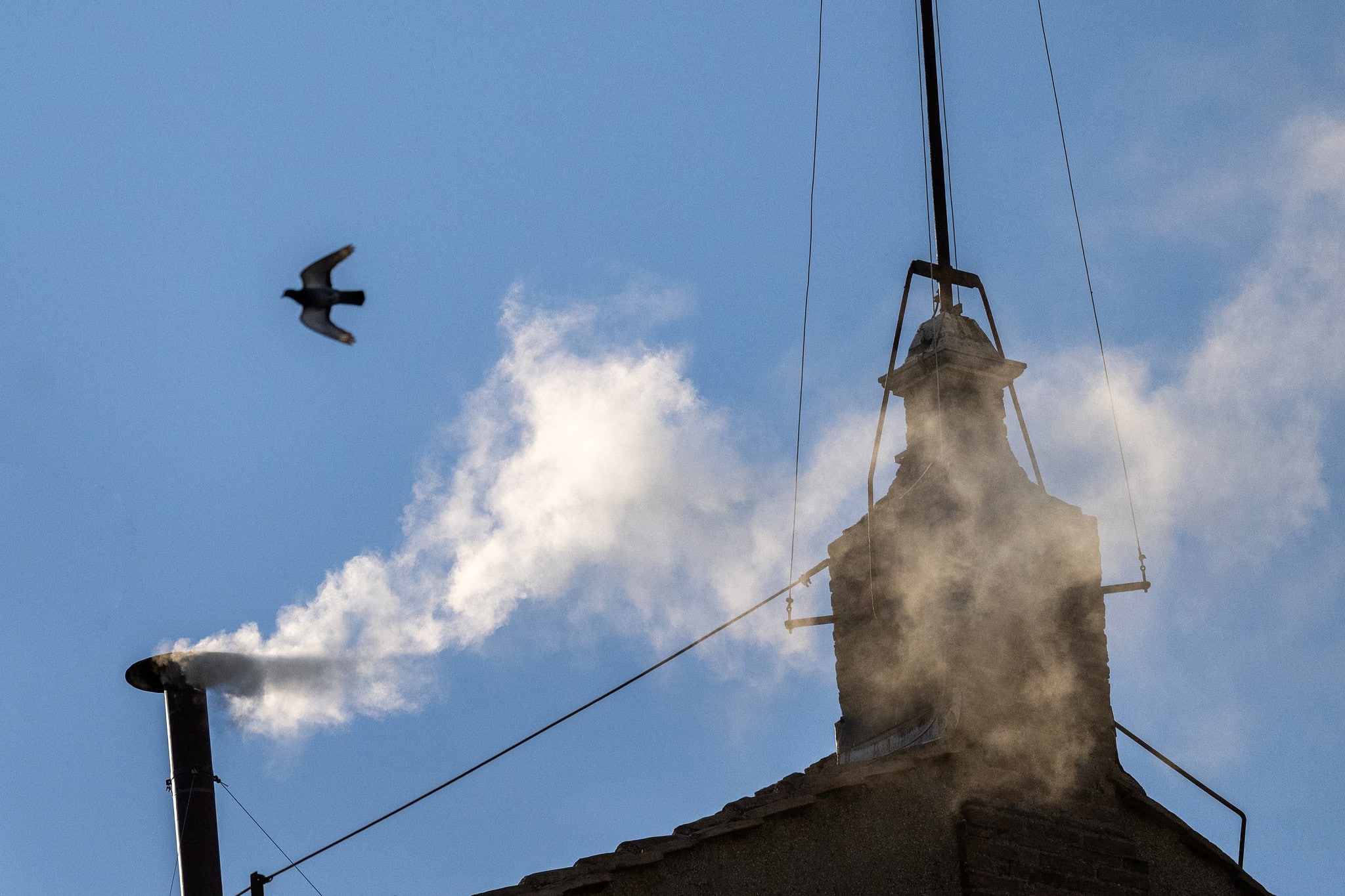
of the universal Church – Habemus Papam!
I don’t think the cardinals timed it this way on purpose—
but the Holy Spirit might have had a calendar handy.
(light chuckle)
And then, he spoke of the Church
as a beacon in uncertain times.
A Church called to shine light amid rapid change—
from global migration
to families stretched thin by everyday pressures.
A Church that still hears the cry of the poor,
still believes in joy,
still believes that Christ is not silent.
[pause]
This is Good Shepherd Sunday.
And the voice of the Shepherd is not an echo from the past.
It still speaks.
Jesus says in today’s Gospel:
“My sheep hear my voice; I know them, and they follow me.”
That’s not just poetry.
That’s a promise.
We are not anonymous to God.
We are not forgotten in the crowd.
“Je vous connais,”
he says.
“Yo te conozco por tu nombre.”
I know you by name.
And… I call you—
not just to feel safe in the fold,
but to follow.
[pause]
When I first arrived here at Resurrection—
in the middle of the pandemic—
we were gathering in person,
but with great caution.
Mass was held here and in the parish hall,
families sat six feet apart,
and everyone wore masks.
Everything felt fragile, uncertain, tired.
But the Shepherd’s voice still found a way in.
Through screens, phone calls, even quiet tears.
I think of the immigrant families I met here,
who were worried about jobs, visas, and relatives far away—
and they still showed up to serve.
I think of the teens who stayed connected—
sometimes online, sometimes in other quiet ways—
even when they didn’t feel like talking.
I think of the moms—biological or spiritual—
who held their families together
with a kind of fierce, stubborn love.
They didn’t wait for perfect conditions.
They followed the Shepherd’s voice.
[pause]
Today is also the World Day of Prayer for Vocations.
When people hear that word—vocation—
they sometimes think, “That’s for priests or nuns.”
But vocation is not a job title.
It’s your life’s response to the voice that says,
“You are mine. I know you. I am with you.”
I think of a parishioner I met during my time here.
She worked at night,
cared for her grandkids during the day,
and still found time to bring Communion
to a neighbor who was homebound.
She never used the word ‘vocation’,
but that’s exactly what it was.
For some, yes, that response becomes
a vocation such as father, nun, deacon, sister, brother.
But for many,
that call shows up in a hospital breakroom,
at a classroom desk,
in the kitchen before sunrise,
in caregiving, in protesting injustice,
in simply showing up for someone who’s struggling.
“The sheep hear his voice.”
Not because they’re perfect.
But because they belong to him.
[pause]
The second reading from Revelation
shows us a vision of heaven:
“a great multitude, from every nation,
race, people, and tongue.”
It’s not a quiet retreat.
It’s a loud, diverse, joyful crowd—
crying out, not with fear, but with confidence.
They have been through tribulation.
And yet they sing.
Because the Lamb has become their Shepherd.
He leads them to life.
Doesn’t that sound like Church of the Resurrection?
On any given Sunday, you’ll hear
English, Spanish, French,
and other languages from around the world…
You’ll see families from all over the world
gathered around one table.
You are already that multitude.
That multitude in Revelation isn’t waiting for heaven.
It’s happening now.
Every time we gather around this altar,
different languages, different backgrounds,
different stories,
we join in that same song.
The Lamb is at the center,
and we are not strangers to one another.
[pause]
And now we have a new Pope—Pope Leo XIV.
He chose his name to echo the other Popes Leo,
and in particular Pope Leo XIII,
who championed the rights of workers and the poor
in the wake of the industrial revolution.
This Pope, too, is stepping into a time
of upheaval and polarization—
and he’s already pointing us outward.
To the edges.
To the uncertain places.
To the people the world forgets:
those sleeping in shelters,
those who feel unwelcome in the Church,
those wondering if anyone still sees them.
He’s asking us to be a Church that listens
and a Church that walks.
Not a fortress.
But a field hospital.
Not a stage.
But a path.
“I know them, and they follow me.”
[pause]
And on this weekend, we also give thanks for our mothers.
For those who raised us—
and those who mothered us in other ways.
For the ones still with us
and the ones we long to see again.
For the women who hoped to be mothers
and carried that longing with grace.
For the grandmothers, godmothers,
sponsors, teachers, tías, mentors—
women whose love has helped us hear God’s voice.
If you are a mother in any of those ways,
thank you.
You teach us what it means to care for the flock.
[pause]
So what do we take with us today?
We are not just celebrating a theme.
We are being invited into a way of life.
The Shepherd still speaks.
He still calls.
He still sends.
In English: “I know you. Follow me.”
En español: “Te llamo por tu nombre. Ven, sígueme.”
En français: “C’est ton nom que j’appelle. Viens, marche avec moi.”
[pause]
Whether you are young or retired,
new to the faith or long on the journey,
certain of your call or still unsure—
Christ knows you.
And Christ is calling.
To the altar.
To the margins.
To the next act of love.
[pause]
The Shepherd still speaks—
and his voice is for you.