February 16, 2015
India update: Feb. 14
We traveled by bus today to a project unique in the world called Auroville, in the region of Pondicherry. Auroville seeks to be a universal town where men and women of all countries are able to live in peace and progressive harmony, above all creeds, all politics and all nationalities. The purpose of Auroville is to realize human unity.
Auroville was founded in 1968 under the spiritual leadership of Sri Aurobindo and a French woman, Mira Alfonso, who had come to Pondicherry in 1914 and met Sri Aurobindo. She worked with him from 1920 until his death in 1950 and came to be called “the Mother.” She created a center of education that was revolutionary in its aim and methods.
Sri Aurobindo was born in Calcutta but was sent by his parents to England at age 7, and he was brought up in a European culture before returning to India. He dreamed of a synthesis between East and West. After his death, in 1968 the Mother created Auroville as a laboratory for this synthesis, inviting people from different cultures to live and work here together. At the inauguration ceremony, representatives of 124 countries and 23 Indian states placed a handful of earth from their homelands in a lotus-shaped urn, in a symbolic gesture of human unity.
Once a barren plateau of red earth, Auroville has been transformed into a lush green 2,000 acres in which a city is progressively beginning to take shape. It has about 2,500 inhabitants who are engaged in a wide range of activities including a cashless economy, environmental regeneration, organic farming, renewable energy, appropriate building technology, handicrafts, health care, education and cross-cultural communication.
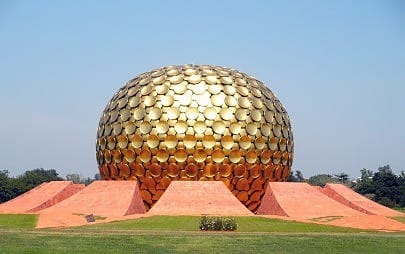
The soul of Auroville is the Matrimandir, a magnificent golden dome symbolizing the call to progressive human unity. It is a place for meditation and for coming to fuller consciousness. There are 12 meditation rooms within it, and at its center is a glass globe with a ray of sunlight from above illuminating it.
A poster near the visitor center presents the conditions for an enduring unity. “The most important idea is that the unity of the human race can be achieved neither by uniformity nor by domination and subjection. Only a synthetic organization of all nations, each one occupying its true place according to is own genius and the part it has to play in the whole, can bring about a comprehensive and progressive unification which has any chance of enduring.
“And if this synthesis is to be a living one, the grouping should be effectuated around a central idea that is as wide and high as possible, in which all tendencies, even the most contradictory, may find their respective places. The higher idea is to give people the conditions of life they need in order to be able to prepare themselves to manifest the new face that will create the race of tomorrow.”
So, it came as somewhat of a surprise when the visitor center orientation film ended with “Auroville is for those who wish to live a divine life but who renounce all religions.”
On our way to visit the tomb of Sri Aurobindo and the Mother, I asked our guide what this statement says about nations – “Each one occupying its true place according to is own genius and the part it has to play in the whole.” – could not apply to religions as well. She smiled and said, “That’s a very good question. There are two kinds of ashrams in India, religious and non-religious, and the administrative board of the Auroville Association decided that this would be a non-religious ashram.”
So, in the end, Auroville is an attractive experiment in communal living and volunteer service for the “Nones”.