February 13, 2015
Mahabalipuram is one of the 16 World Heritage Sites being protected and developed by the Archeological Survey of India. The small town contains around 25 monuments, and we devoted the first half of our day to seeing several of them. They are the structural legacy of the Pallava kings of the 6th century. They take various forms: rock-cut caves excavated from hills; structural temples and bas-reliefs carved out of the boulders on hill edges. They feature sculptures of the Hindu trinity – Brahma, Vishnu and Shiva – in different forms and incarnations. Gratefully, our guide helped us identify the different figures and stories portrayed in the sculptures. The complexity of Hindu devotions can make your head spin!
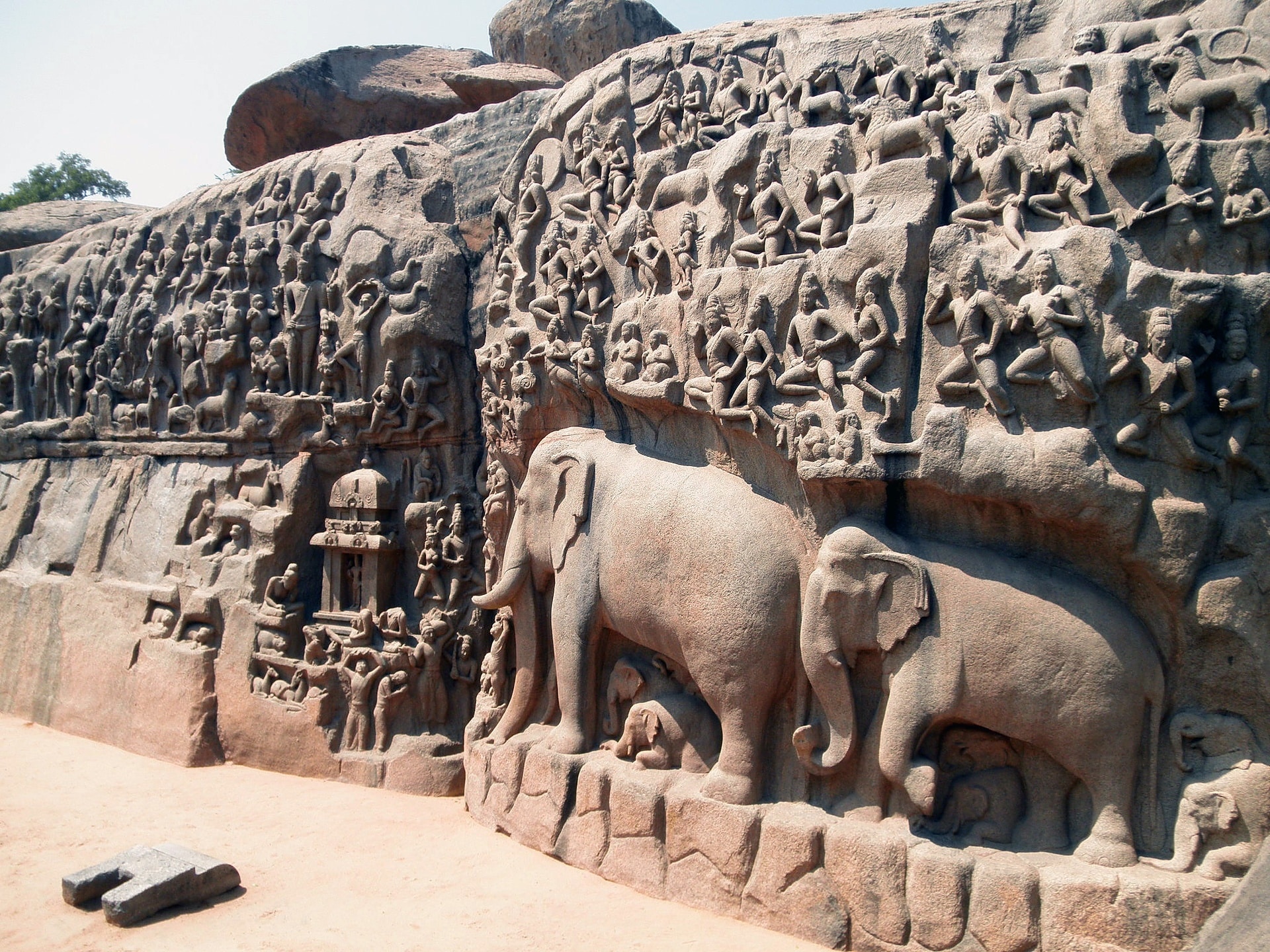
One of the bas-reliefs carved out of a wall of stone is called Arjuna’s Penance, and is hailed as one of the major glories of India art and the largest in the world. At 96 feet long and 43 feet high, it contains chisel-sketches of the denizens of the triple world of God and demi-gods; of human beings, birds and animals; and of nagas and nympths. In a nutshell, the bas-relief represents everything, including elephants, deer, lions, boar, rats – all full of life. The figures number nearly 1,000.
This stone fresco can serve as a microcosm of Hinduism, a religion which has no founder and is, in a certain sense, inaccessible. It is a complex mass of religious systems, a mosaic of probably all known forms of religion, philosophies, social structures, rich traditions and myths of peoples from various epochs.
What do Hindus believe anyway? A Hindu is a pilgrim in search of the Absolute Truth. His/her essential characteristic is the discovery of the internal world. The ultimate aim is to experience total union with the Absolute. There is no one uniform way to reach this ideal; each one is encouraged to tread one’s own path and discover one’s own way. In the final analysis, one is not expected to adhere to any dogmatic beliefs. God is supra-personal, ineffable.
The Divinity is intimately close to us, and yet is utterly transcendent and Absolute Other. The Divinity is the One who descends as a personal friend. The Divinity is omnipresent, omniscient, omnipotent, eternal, benevolent, blissful, imperishable, self-revelatory and self-illuminating, greater than what is predicted of it, without attributes, without form, without limitations.
When a group of tourists from the Western world stands before a high temple covered with gods and goddesses, the habitual response is to identify this as idol worship. But what it really wants to say is that God is a hidden God whose divinity lies obscured by the veils of mundane existence only to burst forth on occasion in all splendor and power. In short, the power of Divinity pervades all that exists, so anything is eligible to be a manifestation of the Divine.
We were back to our hotel for lunch and to enjoy the pool, walk on the beach, do our best to identify our photos, catch up on our journals, and just enjoy some good conversation.