February 12, 2015
There are just three sites in the world where a church is built over the tomb of one of Jesus’ apostles: St. Peter’s in Rome; Santiago de Compostella in Spain (St James); and St. Thomas in Chennai, India. Thomas came to India in 52 A.D., and it is said that he was speared to death in 72 A.D. while praying before a stone cross on what today is called St. Thomas Mount about 6 miles from Chennai’s city center. The body was reportedly taken into the city and buried. A basilica was built over the tomb by Portuguese explorers in the 16th century, and rebuilt by the British in neo-Gothic style in the status of a cathedral in 1893.
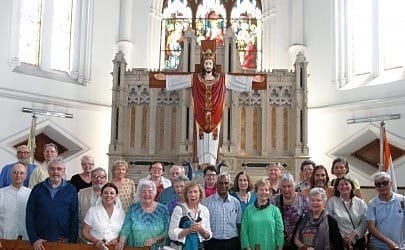
We celebrated Mass together in the tomb chapel, and after, met with Father Vincent Sekhar, SJ, to talk about relations between people of different faiths in India today. Father Sekhar is the executive director of research at the Institute of Dialogue with Cultures and Religions, a doctoral degreee Institute affiliated with Madras University. He is also the secretary for interreligious dialogue for the Jesuit Conference of South Asia, and director of campus ministry at Loyola College in Chennai. The Jesuits have 4,200 members and 19 provinces in India.
Given the attacks on Christian churches since the election last October of Hindu nationalist prime minister Narendra Modi of the Bharatiya Janata Party – a strong national party supported by Hindu fundamentalists – it was a privileged opportunity for us to get an informed sense of what is currently happening in the country. In the news during the past week has been the arrest of 150 Christians in New Delhi who were making a silent protest demonstration in response to the lack of any government action relative to the attacks.
“Modi doesn’t seem to care to open his mouth on the subject,” said Father Sekhar. Hindu fundamentalists want to consolidate all Hindus around one ideology and way of living: Hindus are meant for India and India is meant for Hindus. As for Muslims and Christians, the fundamentalist approach is, “You better abide by our law.” The fundamentalists, however, represent just 1 percent of the population. Overall, said Father Sekhar, Hinduism is pluralistic in its very nature and able to accommodate other faiths and ideologies.
“There are many secular groups fighting for the government to follow the democratic constitution,” he said. “India will continue to be a country where people can live together harmoniously.”
Christians, he noted, who compose at most 5 percent of the population, “are very strong in education and social service, but schools and charitable organizations don’t have much political influence.”
We also talked with him about inculturation of Christian faith and practice in India, and he hopped on his “two wheeler” (motorcycle) and took us over to the local Jesuit seminary and showed us the arrangement of the chapel with the priest and congregants sitting on cushions and the altar and pulpit just slightly elevated above the floor. On one wall is a painting of Mary in a sari with a red dot on her forehead and on another a sculpture of Jesus sitting in a lotus position. A musician as well, Father Sekhar gave us an example of liturgical music composed in the chant style of India to the beat of a drum.
On our way to our night’s lodging in Mahabalipuram, we made a brief stop at Kapaleeshwarar Temple, a sacred Siva temple shrine in Mylapore. The temperature today was in the high 80s, so we are delighted that our hotel for the next two nights has a lovely large outdoor swimming pool and a short walk to the ocean beach.