February 7, 2015
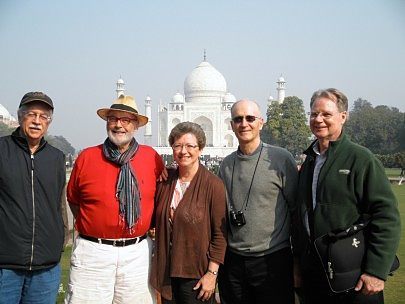
We overnighted in Agra in Jaypee Hotel, the largest (381 rooms) many of us have ever been in. Just finding the way from one’s room to the dining room requires an acute sense of direction. The hotel’s size is but an indication of how many people come from around the world to see the “dream in marble” called the Taj Mahal, and the great love story behind it only enhances its beauty.
The Taj was built by the Moghul Emperor Shah Jahan to enshrine the remains of his beloved wife who had borne him 14 children.
“You are the crown (Taj) of my palace (Mahal),” he liked to say to her. Begun in 1631, a year after the Queen’s death, the Taj took 22 years and the effort of 20,000 men to bring it to completion. The Emperor Shah Jahan’s own remains lie next to those of his wife, Arjumand, under the main dome. It was under his reign that Agra reached its peak of glory as the city of immortal architecture.
Our guide identified a variety of salient features that make the Taj special: Architectural beauty. Pinpoint accuracy in measurement. Symmetry. Its centrality in the middle of the garden. Its embellishment with inlaid precious stones. Its blue sky backdrop. The calligraphy in marble of verses from the Qur’an which frame both the entrance to the main gate and to the Taj itself.
The former, drawn from sutra 69 in the Qur’an, conveys the emperor’s love for his wife who died shortly after bearing their 14th child: “O soul, thou art at peace with him and he at peace with you. Enter into the garden of his kingdom as one of his humble servants.”
Our second stunning visit of the day was to the Agra Fort. When we hear the word “fort,” we tend to think of a military fortification with nothing fancy within it. Not the case with the forts in this region of India! Within the mile-long circumference of Agra Fort’s surrounding red sandstone wall there are several magnificent buildings whose marble walls and pillars and ceilings are richly inlaid with elaborate designs in valuable stones, to say nothing of fish tanks, flower beds, water channels and fountains.
Yes, fortification was required because those who lived within the fort needed to protect themselves from the attacks of kings in neighboring regions.
In the case of Agra Fort, it was the Muslim Mughal emperor who needed to protect his family and cohort from the attacks of surrounding Hindu kings who were under his domain now because the rivalries among themselves as Hindu kings prevented them from uniting to defend themselves against the early 16th century Mughal invasion.
The Mughals, who came from Uzbekistan, ruled India up to the mid-19th century when ultimately they were routed from power by the British. And the British held sway until the mid-20th century when, under the revolution led by Mahatma Gandhi, India became a democracy.