August 10, 2009

Summer is a time of light and growth, both in the outdoor world and in our inner world. It is in our spiritual summer that we see glimpses of truth that may have been hidden from us in other seasons. Discoveries we would doubt or easily pass by in other, busier times of the year are revealed and accepted in backyard barbeques and lingering conversations over supper.
The truth of this can be experienced in our friendships with members of other churches. Summer’s “lazy time” moments of sitting outdoors on lawn chairs and relaxing represent an easy and enjoyable way to deepen relationships that can bear both internal and external fruit.
The better we get to know one another – no matter how different our backgrounds – the more we recognize similarities between us. The Christ in me warms to the Christ in the other. The closer we draw to the center of our faith lives, the closer we draw to each other.
Friendship consists of three basic moments. First, friends enjoy one another’s company. Next, they render service to one another. And finally, they share a commitment to the common good.
It wasn’t by accident that the Week of Prayer for Christian Unity emerged from the efforts of friends in different churches (Lord Halifax, an Anglican layman, and Abbé Fernand Portal, a French Catholic priest; and another Anglican, Rev. Spencer Jones, with Father Paul Wattson). Could there be a more fitting symbol of what God can do through persons open to the grace of Christian friendship and committed to pursuing the common good?
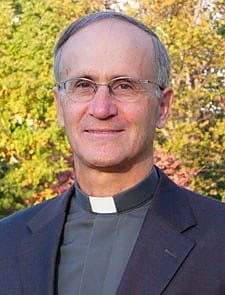
Father Thomas Ryan, C.S.P.
The effect is similar to that which two vibrating objects exert on one another. Two grandfather clocks placed side by side, for instance, will, within 24 hours, adjust the swing of the pendulums so they are in synch. Two living cells from a heart will beat all by themselves. They will begin to beat together if placed close to one another; if touching, will bend to form a little two-celled heart and pulse in rhythm.
The ecumenical movement is not just a march of ideas, but a procession of people. Leaders are needed, but they cannot be planned in advance. They simply emerge. And often, their vision of what could be has been sparked by an encounter with someone from another church whose words or person touched them.
In our quest to give more visible expression to our unity with one another, doctrinal agreement is an important part of the equation, but it is not the only part. You can have it and still remain divided.
At the Council of Florence (1438-1445), the Greek leaders met with officials and theologians from the Latin West. After long and painful discussions, a doctrinal agreement was worked out. All but one of the Greek bishops at the Council accepted it.
However, when the Greek bishops and theologians returned home and announced the reunion with the Latin West, the people answered with a rousing “No!” They had no love for the Latins, nor did they want to live with them in one body. Union worked out by ecclesiastics and theologians on the basis of doctrinal agreement had no firm foundation in the community. Love, trust, and a desire to be of mutual service and support were lacking. The plan of reunion failed.
The house of God’s dreams, the one church of Christ, must be built up from below, from the ground level, with the “living stones” of the lives of congregational members. When people who have been living next door to each other – attending town, neighborhood or school meetings together, coaching local children’s teams, mixing socially – expand their sharing of life to include a sharing of faith, they make their own vital contribution to the work in progress.
And in the long, lazy light of summer, in boat rides and picnics and backyard barbeques, it can even be fun. Suppose you were to invite your acquaintances from another church to come over precisely because they are from another church?
Father Thomas Ryan, CSP, directs the Paulist North American Office for Ecumenical and Interfaith Relations in Washington, D.C.