May 15, 2014
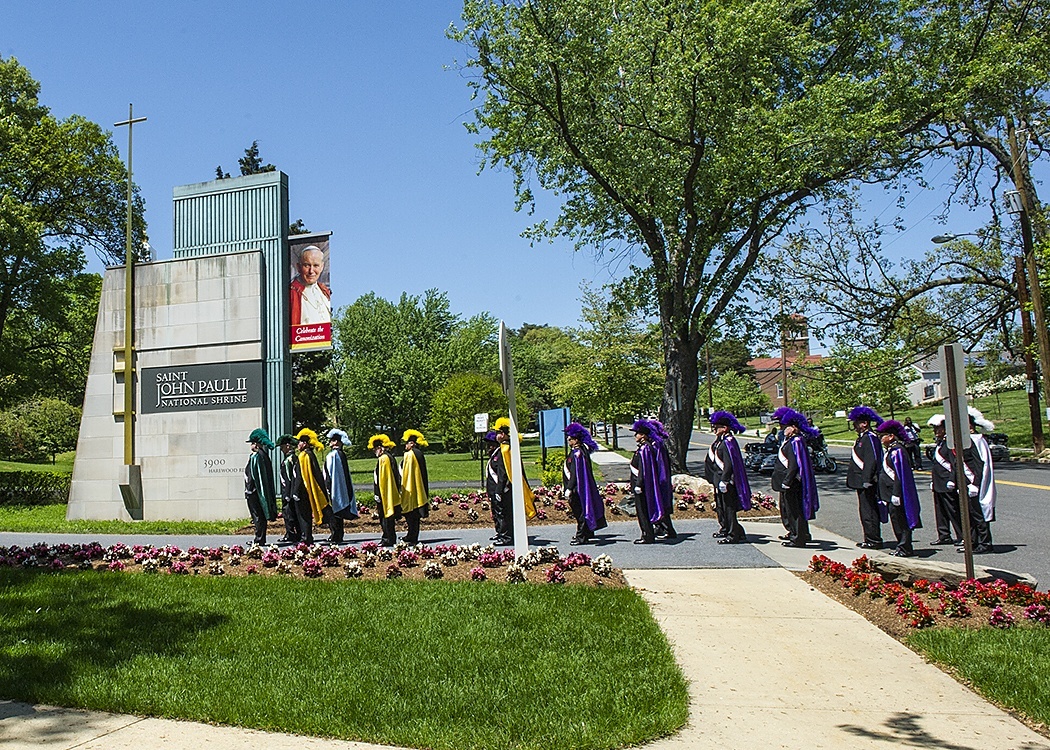
The National Mass of Thanksgiving for the canonization of St. John XXIII and St. John Paul II at the Shrine of the Immaculate Conception in Washington, D.C., couldn’t have fallen on a more appropriate day: Good Shepherd Sunday [May 11 this year]. It was a full house with 3,500 worshippers. After the Mass, there was a procession out of the church and up the avenue alongside the Basilica to the St. John Paul II National Shrine.
The procession was led by approximately 100 Knights of Columbus with their colorful capes and white feathered hats fluttering in the breeze, followed by priests and bishops vested in white, and behind them hundreds of people, everyone joining in singing the litany of the saints.
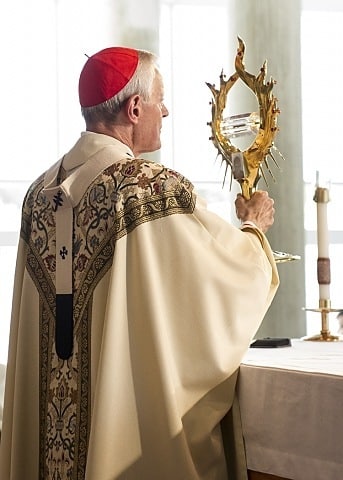 Everyone went into the St. John Paul II National Shrine to pray the Chaplet of the Divine Mercy, followed by veneration of a first-class relic of St. John Paul II – a vial of his blood, still in liquid form, held within a golden frame shaped like flames decorated with 12 red stones representing the 12 apostles.
The image we may have of a shepherd is that of a person standing quietly on a hillside. But the fact is that a shepherd back then and even now has to be strong, hardy and fearless, ready to ward off wolves, bears and – depending on what country you’re in – possibly even lions. Shepherds must be alert and diligent and adaptable to harsh conditions. And the two shepherds whom the faithful honored on Good Shepherd Sunday were exactly that.
Before becoming Pope John XXIII, Angelo Roncalli served in Bulgaria and Turkey during the time of World War II, helping Jews fleeing the Nazis. And John Paul II, during his years of service, even took a bullet in the side. They knew the hard realities of being a shepherd; it wasn’t just a cute, quaint image for them. Both also had the courage to lead the way into new pastures.
The Acts of the Apostles relates Peter’s experience of going into the home of Gentiles, praying with them, and experiencing the presence of the Holy Spirit among them. He then went back to his own followers and set a new tone among them for such encounters (Acts 11).
Pope John XXIII acted similarly when he convoked the Second Vatican Council , which formally set a new tone for the Catholic Church’s view of other religions and other believers. As Jesus said in John’s Gospel: “I have other sheep that do not belong to this fold. These also I must lead (10:16).”
Pope John XXII’s assertion that the Church had to reassess its whole relationship with the Jewish people was the inspiration for Nostra Aetate – which led the Church to begin to look at its relationship with all other religions. John XXIII was the shepherd who led his flock into new pastures, and everything later popes did followed those new pathways and took them to new heights.
Pope Paul VI and Ecumenical Patriarch Athenagoras met in Jerusalem, embraced and rescinded the excommunications at the root of the Great Schism in 1054 between the churches of the East and West.
John Paul II was probably the first pope since St. Peter to visit the Rome synagogue, and was the first to pray at the Western Wall in Jerusalem, leaving amid its stones a prayer asking God’s forgiveness for Catholics’ past hostilities to Jews. He spoke to a stadium full of young Muslims in Casablanca, visited the Umayyad Mosque in Damascus, and invited all the world’s major religions and several local indigenous religions to Assisi to pray for peace.
Pope Benedict picked up from where his predecessor left off. In his first sermon after his election, he said that “the primary goal of my pontificate will be the restoration of unity among Christians,” and “to those who follow other religions … the church wishes to engage with them in an open and sincere dialogue in search of the true good of humanity and society.”
He visited a mosque in Cologne, Germany, and called for a renewal of Jewish-Christian dialogue. As an expression of his commitment to Muslim-Christian dialogue, the pope visited and prayed in a mosque in Turkey. And in response to a letter from 138 Muslim scholars, Pope Benedict approved the establishment of the Catholic-Muslim Forum, which brings together Vatican officials and Muslim scholars for annual dialogue.
And on May 24-26, Pope Francis is going to Jordan, Israel and Palestine. He will meet separately with the Muslim Grand Mufti of Jerusalem, the two Chief Rabbis of the Great Synagogue, the Ecumenical Patriarch Bartholomew and some Palestinian families.
With leaders such as this, past and present, the ears of the flock remain attuned to the voice of the Good Shepherd as they continue to go forth into new pastures.