February 10, 2015
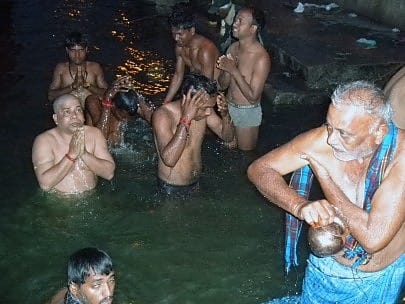
The wake-up call this morn was 5 a.m., and at 5:30 we were on the bus and headed back to the river to witness the rituals of people bathing in the Ganges by the light of the rising sun. The Ganges is sacred everywhere in India, for the Hindus believe that the river washes away sin. The souls of the dead are also believed to go to heaven and if their ashes are immersed in the sacred waters.
The very gods, they say, come to bathe in the Ganges. To be sure, the water is not what you would call “clean,” but the people believe that only good can come of it.
Once again, we got in a large rowboat and moved slowly along the shore, observing the rituals. In addition to the bathers, we even saw one fellow brushing his teeth with the river water. We also passed some bodies being cremated, coming within a few feet of two of them once we had exited the boat and were just walking along the shore.
After breakfast, we headed for the hamlet of Sarnath, one of the most important places of worship for Buddhists, about seven miles from Varanasi. It was here that the Buddha preached his first sermon, summing up the essentials of Buddhist teaching. Our first stop was at the main temple in Sarnath today, the Mool Gandh Kuti Vihar Temple. The temple provides a home for the relics of Siddartha Gautama, the Buddha. The interior temple walls are covered with murals depicting his life story. It is built on the spot where the Buddha is said to have rested and meditated during the monsoon season.
From there we went to Deer Park, where one can walk through the archeological ruins of a 5th century A.D. monastic complex in which the still-standing huge Dhamek Stupa/tower marks the place where the Buddha preached his first sermon to his first five disciples. Built in the 3rd century, it was originally almost twice as high as it is today. The ruins of four other monasteries that grew up in that area between the 2nd and 4th centuries A.D. cover the grounds today and evoke the experience of walking through the ancient Roman ruins.
Sarnath continued to flourish till the coming of Islam in India. Late in the 10th century, Muslim Turks executed a campaign of raids, and the unfortified Buddhist monasteries offered easy pickings. Buddhists were considered “idolators” by the Muslims because of the images of Buddhas and bodhisattvas which adorned their monasteries. Works of art were destroyed and libraries burned to the ground. In 1192, a Turkish tribe established rule over north India in what was the first in a series of Muslim dynasties. Bu by the time the British came in the 17th century, it was too late.
the 7th century A.D., there were 30 Buddhist monasteries and 3,000 monks in nearby Varanasi. In the area of Varanasi and Sarnath today, the population is 70 percent Hindu, 20 percent Muslim, 5 percent Christian, and 5 percent all other religions, with less than 1 percent being Buddhists. As if to demonstrate the truth of its own teaching that everything is impermanent, Buddhism all but disappeared from the land of its birth.