February 17, 2015
India update: Feb. 16
We rode a couple hours through the southern countryside from Tanjore to Trichy, where we visited the Shriangam Temple, considered the most important of the 108 main temples in India dedicated to Vishnu, who is the second one normally named in the Hindu trinity of Brahma, Vishnu, Shiva. The temple complex covers 156 acres on which there are 21 magnificent towers that are among the most colorful in India. Unfortunately, we were only able to scratch the surface of the beautiful temple complex because the towers have been undergoing a repainting for the past year and are largely covered by a sunblock cloth behind which the painters do their work on a scaffolding of tree branches tied together with rope – a work of art in itself!
From there we went onto our final destination where we will spend our remaining day and a half—the Benedictine Camaldolese ashram of the Holy Trinity called Saccidananda (literal Sanskrit: Being, Consciousness, Bliss).
The ashram of the Holy Trinity, was founded in 1950 by two French Fathers – Jules Monchanin, who took the name of ParamaArubiAnanda (the bliss of the Supreme Spirit) and Henri Le Saux, who took the name of Abhishiktananda (the bliss of Christ).
The priests sought to identify themselves with the Hindu “search for God,” the quest for the Absolute, which has inspired monastic life in India from the earliest times. They also intended to relate this quest to their own experience of God in Christ in the mystery of the Holy Trinity. Father Monchanin died in 1957 before the ashram could be properly established, and Swami Abhishiktananda, after remaining for some time alone at Shantivanam, eventually settled as a hermit in the Himalayas, where he died in 1973.
In that interim, the ashram, located in Shantivanam (Forest of Peace), was taken over by a group of monks led by Father Bede Griffiths from Kurisumala Ashram in Kerala. Since 1980, Saccidananda has been part of the Benedictine Order as a community of the Camaldoese Benedictine Congregation. Father Griffiths passed away in 1993. At present the community consists of 10 permanent members, three students, two novices and three postulants.
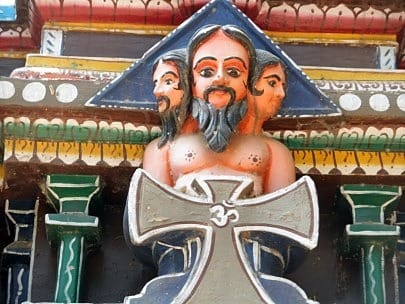
The aim of the ashram is to establish a way of contemplative life based on the traditions of Christian monasticism and Hindu Sannyasa (renunciation of the world in order to seek God, or “liberation”), which goes back several centuries before Christ and continues to the present day. Saccidananda ashram seeks to assist in the meeting of these two great traditions of spiritual life by bringing them together in the ashram’s art, architecture and life of prayer and contemplation.
The accommodations are basic but adequate. The food is simple and vegetarian, southern Indian with mostly rice-based meals – a far cry, to be sure, from what we’ve been enjoying in hotel buffets. But Father Tom Kane, CSP, and I chose to end our journey here both to provide our group with a quiet prayerful environment in which to process all we’ve lived in this study tour, as well as to give people an example of what the interfaith and intercultural encounter can look like in practice. More on that tomorrow.