February 17, 2015
India update: Feb 17
This spring, we celebrate 50th anniversary of the Vatican II document Nostra Aetate, which discusses the Church’s relationships with other religions. One of the things the Council Fathers said in it is that “the Church rejects nothing that is true and holy in these religions,” and encouragement is given to Catholics to “recognize, preserve and promote the spiritual and moral values as well as the social and cultural values to be found among them.”
Following this direction, the All India Seminar in 1969, which was attended by the hierarchy and representatives of the whole Catholic Church in India, spoke of the “wealth of truth, goodness and beauty in India’s religious tradition” as “God’s gift to our nation from ancient times.” The seminar showed the need of a liturgy “closely related to the Indian cultural tradition,” and theology “lived and pondered in the vital context of the Indian spiritual tradition.” In particular, the need was expressed to establish authentic forms of monastic life in keeping with the best traditions of the Church and spiritual heritage of India.
Among the gifts given by God to India, the greatest was seen by assembly participants to be that of Interiority: the awareness of the presence of God dwelling in the heart of every human person and every creature, which is fostered by prayer, meditation, the practice of yoga and Sannyasa. “These values” it was said, “belong to Christ and are a positive help to an authentic Christian life.” Consequently, “Ashrams where authentic incarnational Christian spirituality is lived, should be established.”
The aim of Saccidananda ashram, therefore, following these directions of the 1969 All India Seminar, is “to bring into our Christian life the riches of Indian spirituality, to share in that profound experience of God which originated in Vedas, was developed in the Upanishads and Bahagavad Gita, and has come down to us today through a continual succession of sages and holy men and women. From this experience of God lived in the context of an authentic Christian life, it is hoped that we may be able to assist in the growth of a genuine Indian, Christian liturgy and theology.”
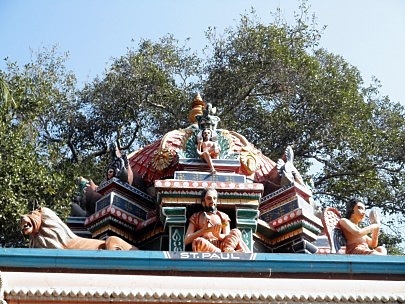
We have had the opportunity to experience that here. The church is first of all built in the style of a South India temple. At morning prayer, we had paste from sandalwood (considered the most fragrant and precious of all woods, and therefore seen as a symbol of divinity) rubbed on our foreheads as a way for consecrating the body and its parts to God.
At the midday prayer, a dot of the purple powder known as “Kumkumum” was placed on the space between our eyebrows as a symbol of the “Third Eye” – the eye of wisdom, the inner eye which sees the inner light according to the Gospel, “if thine eye be single, thy whole body shall be full of light.”
At the evening prayer throughout the year, the ashram places ashes on the forehead, not with Ash Wednesday’s symbolism of “dust you are, and unto dust you shall return,” but because ash is the final product of the matter from which the impurities have been burnt away.
At the end of each of the prayers, the presider waved a burning flame in a circular motion (arati) before the blessed sacrament tabernacle to reveal the hidden God, the hidden Christ, who dwells in the tabernacle of our hearts. After that the flame is brought around and each person places hands over it and draws its warmth to one’s head and heart.
And at the offertory of the Mass, a symbolic offering is made of the four elements: Water, Earth, Air and Fire. Every Hindu puja (offering) consists in the offering of the elements to God, as a sign of the offering of the creation to God. The music is offered in the bhajan India style chant with cymbal and/or drum.
In the morning of this our final non-travel day, I offered a session in two parts to our group, the first on the spirituality of Lent and the second on how yoga in the classical tradition encompasses devotion, service, study, contemplation, and, yes, physical exercises with deep breathing to prepare the body-mind for meditation. In the afternoon, we had a few hours of quiet reflection, a question-and-answer session with Brother Martin of the ashram, and we ended the day with a sharing amongst ourselves of a grace received by each one in the course of our pilgrimage.
We will join the ashram community tomorrow morning for meditation, morning prayer and eucharist, and after breakfast climb into the bus for a six-hour bus trip to Chennai where we will have a celebratory last meal together before getting on the plane to fly home.
Thank you from all of us for your thoughts and prayers for us along the way! This has truly been an interfaith and intercultural study tour!
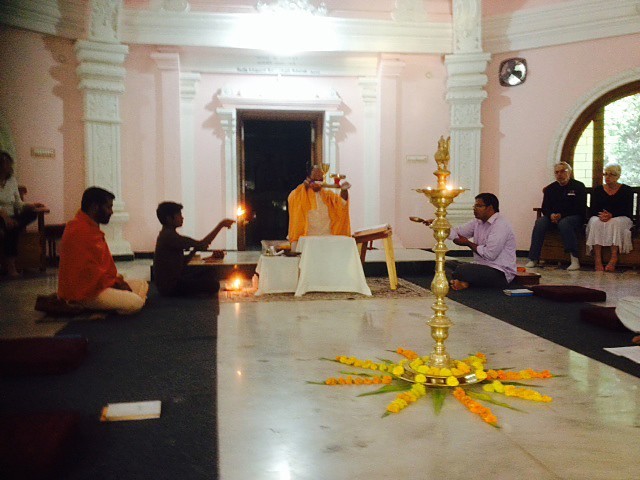
At each offertory of the Mass, the elements of earth (bread and wine), air (incense), fire, and water are lifted up as a sign that the whole creation is being offered as a cosmic sacrifice. The 8 directions of flowers represent the directions of space and signify that the Mass is offered in the center of the universe thus relating it to the whole of creation.
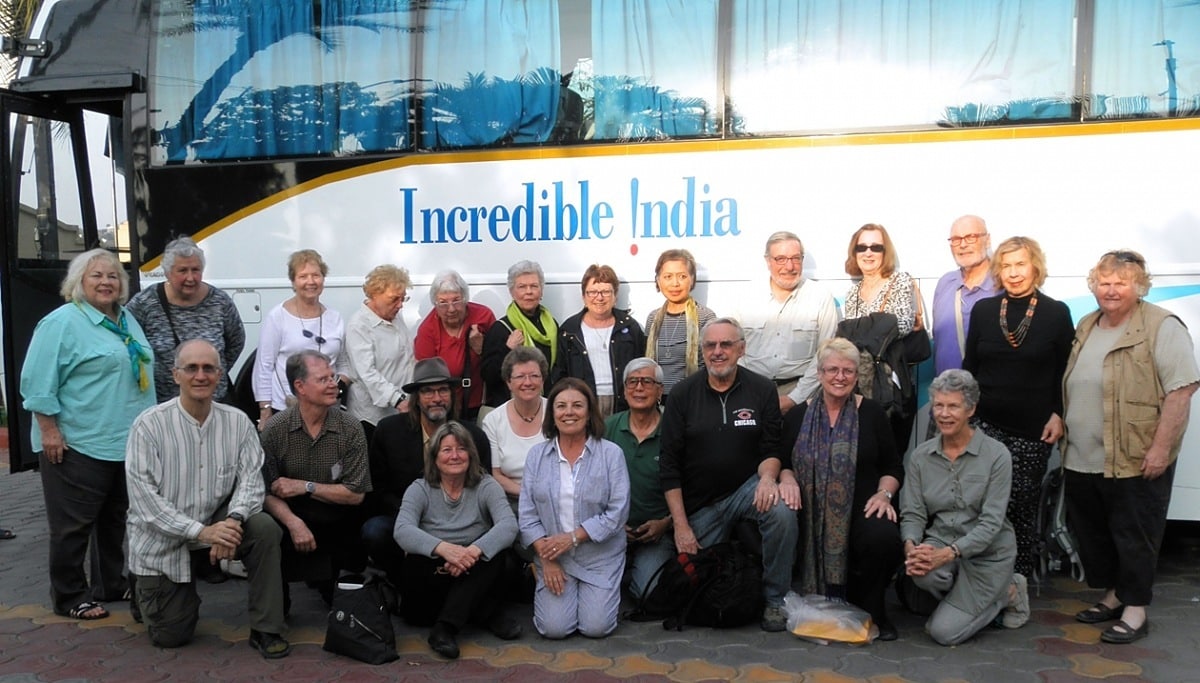
Group photo against backdrop of our appropriately inscripted bus: Incredible !ndia