May 26, 2013
 Father Thomas Ryan, CSP
Mary is often considered to be a major stumbling block on the road to Christian unity in terms of doctrine and devotion, but that is less and less the case. Today Mary is appearing more frequently in Anglican and Protestant liturgical hymns and calendars, and her image is hanging on their church walls.
So said Dr. Max Johnson of the Evangelical Lutheran Church of America (ELCA) and professor of liturgy at Notre Dame University in South Bend, Ind., in his session on “Mary: Ecumenical Convergence” at the National Workshop on Christian Unity in Columbus, Ohio, last month.
The Immaculate Conception and the Assumption of Mary into heaven have been traditional points of discord. We would do better, Dr. Johnson said, to establish our common ground with the Council of Ephesus’ teaching in 431 around Mary as Theotokos (God-bearer) against Nestorius and his followers who took umbrage at the title “Mother of God.”
Marian images and devotions, beginning in the patristic period and coming to full flowering in the Middle Ages, generally depict Mary as mother, compassionate presence, woman of the spirit.
Protestants can find reassurance that honoring Mary does not detract from the centrality of Jesus role, said Dr. Johnson, in considering the close relationship between ecclesiology and Mariology in Catholic theology – Mary as the mother of the Church. Her redemption could come about through no other possible way than free grace.
“Mary was justified from the first instant of her existence. Similarly with regard to the assumption. Ascension implies an active role to the one ascending, whereas assumption only happens by the power of another. Again, what comes to her is dependent on God’s grace alone,” Dr. Johnson said.
He noted that Vatican II’s Constitution on the Sacred Liturgy says that Mary enjoys what the Church hopes to be. Her image invokes the beginning of a graciously redeemed humanity and Church.
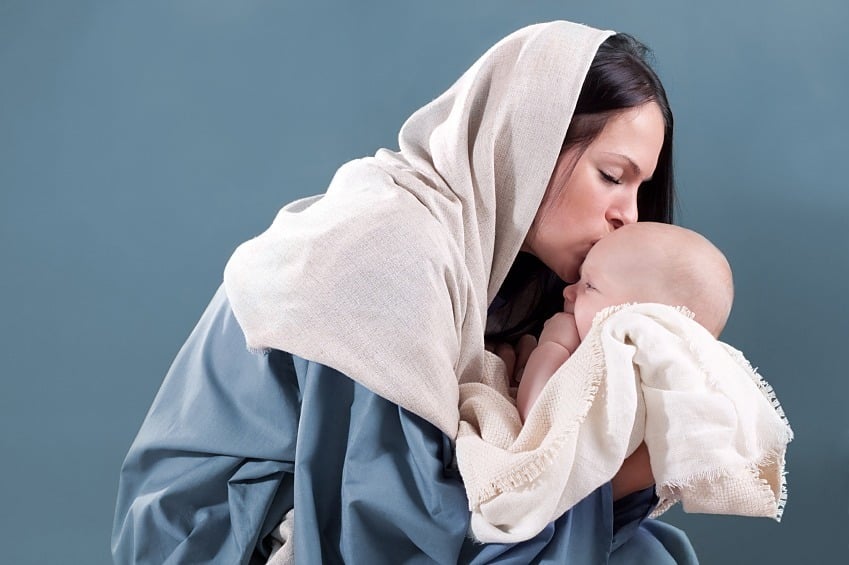
In popular religion and piety today, there is renewed attention to Marian art and to the invocation of Mary among Protestants. Icons of the Theotokos, in which she is always depicted holding the child in her arms, are becoming more present in Protestant worship space. Dr. Johnson noted he has seen such icons hanging in two Lutheran churches in South Bend as well as in the ELCA headquarters in Chicago and in their seminary in Minnesota.
In the 16th century Reformation era, Martin Luther’s own high regard for Mary and devotion to her has not always been well known. Dr. Johnson cited Luther’s 1521 commentary on Mary in which Luther says that Mary is the prototype for us of how God is to be magnified. She magnified God for what God does for us, and did not magnify herself for anything she had done.
In his study “The Thousand Faces of Mary,” Father Georges Tavard notes that Mary’s perpetual virginity, her sinlessness, her purity, her place in heaven were all widely held by continental reformers such as Ulrich Zwingli and Heinrich Bullinger and many Anglican reformers.
Protestants are known for not invoking Mary and the saints, while Catholics may do so though they are not obligated to. There is a clear articulation in Catholic theology of the one mediatorship of Christ, and Protestants need not fear they will be forced to compromise their understanding of the same, said Dr. Johnson.
Catholics’ invocation of the saints is more in the spirit of seeing Jesus continue to do among his followers in heaven what he did on earth: share his mission with them and give them a role to play in carrying it forward in people’s lives. Whatever role they have is by virtue of his delegation and blessing.
As this is better understood, the “Hail Mary” prayer is making a comeback in Protestant circles. Lutheran theologian Robert Jenson justifies it saying, “We believe that the saints in heaven and on earth are joined together.”
Presbyterians in the U.S. now include in their prayer book the feasts of the Annunciation of the angel Gabriel to Mary, the Visitation of Mary to her cousin Elizabeth, and the Presentation of Jesus by Mary and Joseph in the temple, noted Dr. Johnson. And given the growing number of Mexicans and Latin Americans in the country, the Virgin of Guadalupe is appearing in Episcopalian and Lutheran contexts now.
In their 2009 Agreed Statement “”Do Whatever He Tells You”, Catholics and Evangelicals state: “It is necessary to call Mary the Godbearer.”
Appropriate new throughout the year, but especially in this month of May.
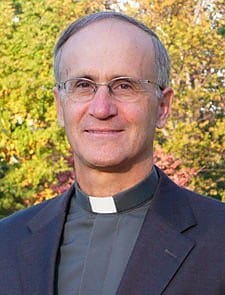
Father Thomas Ryan, CSP, directs the Paulist North American Office for Ecumenical and Interfaith Relations in Washington, D.C.