December 1, 2014
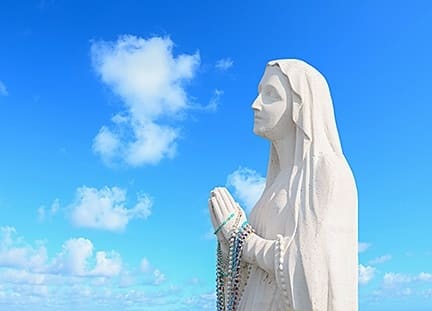
As we head into the Advent season where Mary’s role in God’s plan of salvation is prominently featured in the feasts of the Immaculate Conception and Our Lady of Guadalupe as well as in our nativity sets, the time is ripe to reflect on how Mary is differently perceived among the followers of her son, Jesus, and to ask: How do I see her?
A panel of pastors and scholars of Latin American background did precisely that at an international conference on receptive ecumenism at Fairfield University in Connecticut June 2014. Their topic was “Ecumenical Learning Regarding Mary in a Latin American Catholic/Pentecostal Context.”
Dr. Peter Casarella, associate professor of theology at the University of Notre Dame in Indiana, shared that the Baptist perception in Latin America is that Catholics worship Mary, whereas Baptists worship Jesus. Exaggerated veneration of Mary, the Baptists say, obscures the centrality of Christ.
However, while Baptists reject Marian apparitions, they do nonetheless recognize that Mary can be held as a model for one’s own discipleship. “The situation on the ground,” said Dr. Casarella, “is polarized and divided, marked by misunderstandings on both sides. There is an ongoing need for theological dialogue about Mary. Catholics see her as a model virgin; Baptists as model wife and mother.”
Dr. Nestor Médina, assistant professor of theology and culture at Regent University in Toronto, spoke about Pentecostal perspectives. Marianismo in the Pentecostal context refers to the subjection of women through devotion to Mary.
“The distinct difference between Catholic charismatics and Protestant charismatics and Pentecostals is devotion to Mary,” he said. “She continues to be a contested symbol in Latin America.”
At the same time, however, there is some commonality. “Mary is portrayed as model of faith and devotion, as the mother of God. Pentecostals insist she is a model of holiness and virtue, faith and trust,” Changes in Marian devotions have been going on since Vatican II, Dr. Médina noted, which signaled a shift with its re-emphasis on Mary as a type of the Church. The current multivalence of Marian practices stem from their potential to bring hope and stand in stark contrast to images of Mary – more dependency than agency, suffering servant – seen to contribute to the domestication of women.
“Expressions of Marian devotion and attention to her embodied experience of God should not be ignored,” said Dr. Medina. “Reflection on Mary enables us to see the female body as important in God’s embodiment. She provided the humanity assumed in the incarnation. A life-giving miracle took place in her womb that shows humanity’s compatibility with the divinity.”
Further, Mary’s experience of childbearing helps us to experience God as a source of life. “Women’s bodies mirror the divine creative act. Our understanding of Church must include women’s embodiment and the dismantling of the ecclesial glass ceiling that has stifled women’s contribution to the Church,” Dr. Medina said.
“She entered into an intimate relationship with the divine, and was the first to receive the promise of the Spirit poured out upon others at Pentecost. She so embodies our eschatological hope to become Spirit-filled. We all need to deepen our theology of the Holy Spirit,” said Dr. Medina, noting that what is to be avoided is what often happens among Latinas: many of the Spirit’s characteristics’ are attributed to Mary with the result that Mary frequently replaces the Holy Spirit.
Monsignor Juan Usma Gómez, engaged in Catholic-Pentecostal Relations on behalf of the Vatican’s Pontifical Council for the Promotion of Christian Unity, shared how this can result in accusations of idolatry or paganism, citing the example of a Brazilian Pentecostal pastor in the 1980s destroying an image of Mary on television.
“We need to create favorable conditions for this dialogue,” said Monsignor Gómez. “Catholics and Pentecostals in Latin America don’t look at each other as brothers and sisters in Christ. Relations are marked by competition and confrontation. The acceptance or rejection of Marian devotion is one of main points of cleavage.”
Monsignor Gómez observed that both Pentecostals and Catholics concur: We need to go to the Bible where Mary can be identified as a model for all of faith, devotion and reliance on the Holy Spirit. A model of free acts of cooperation with the Divine. And recognition of the transformative power of the Holy Spirit in Mary is common ground.