October 5, 2009
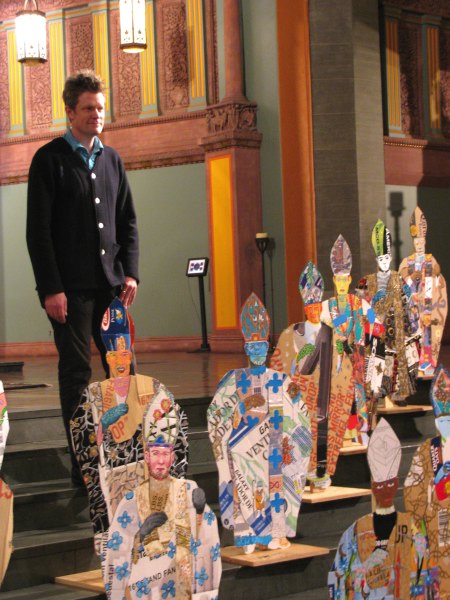
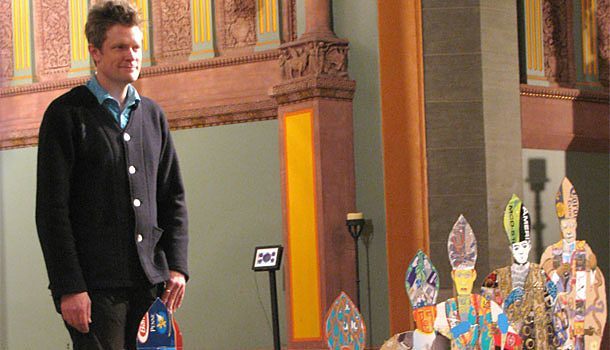 Artist Mark Estabrook stands with his artwork display titled “Popes,” a seriies of 21 pieces made of cardboard, wood, tape, acrylic and metal leaf. Mr. Estabrook was one of 15 artists who displayed their work at “God Doesn’t Like Ugly,” the third art exhibit of Openings, a Paulist Fathers ministry to artists in New York City. ENLARGE PHOTO | START SLIDESHOW
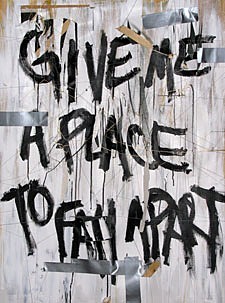 “Give Me A Place To Fall Apart.” Laura Resheske, thread, canvas, paint. ENLARGE PHOTO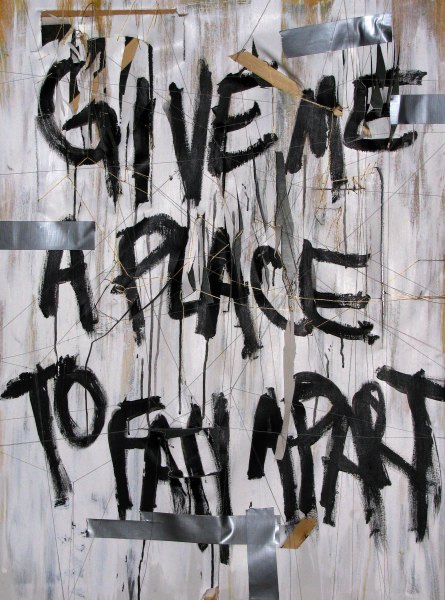
When Mike Estabrook first met Father Frank Sabatte, CSP, during his residency with the Lower Manhattan Cultural Council, he didn’t realize until he looked at the fellow artist’s business card that he was speaking with a priest.
“We had talked about our work,” recalled Mr. Estabrook. “I was surprised he was a priest, and found that interesting. Then, he came to a small opening I had in a place that was not easily accessible. It was a rainy night, and not many people showed up, but he made an effort to come.”
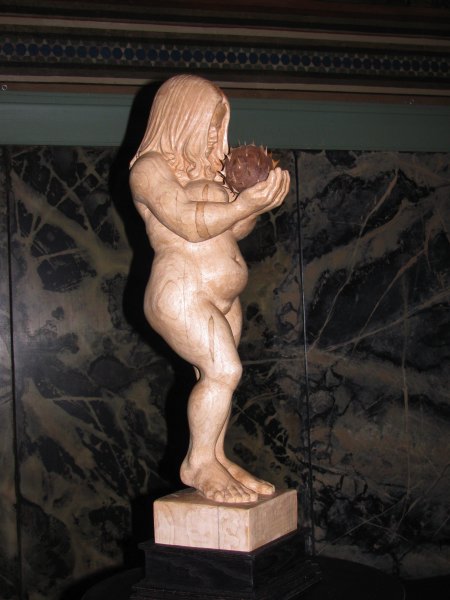
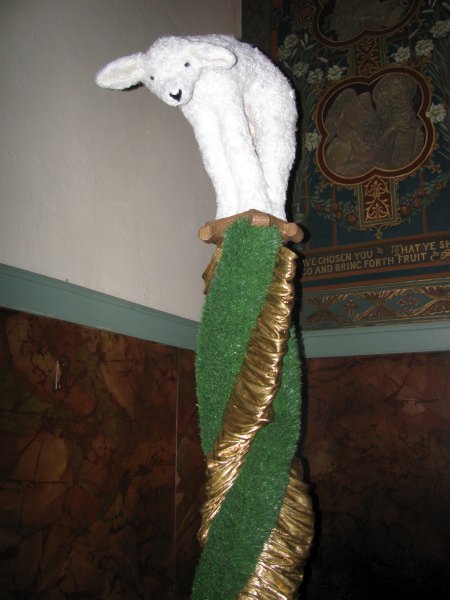
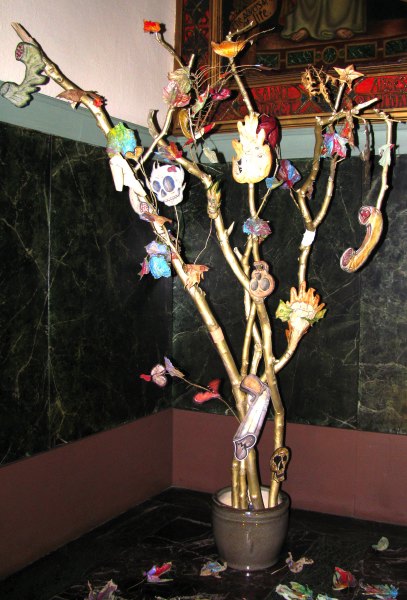
And so Mr. Estabrook joined 14 other artists to display his work at “God Doesn’t Like Ugly,” an art exhibit of the Paulist Fathers Openings ministry at the Church of St. Paul the Apostle in Manhattan that runs through Oct. 30.
It was Mr. Estabrook’s second year displaying his work at an Openings show. His work, titled “Popes,” is a series of 21 mixed media representations of pope-like figures made out of cardboard wood, tape, acrylic and metal leaf.
Mr. Estabrook was inspired by the ornamentation he saw in the raw materials around Brooklyn and the imagery one sees in a church.
“There is a relationship there,” he said, noting that having artwork displayed in a church offers the “thrill of immediate context.”
“There is a reference to history,” he said. “It takes something that is floating in space and grounds it.”
With the artwork being displayed in a church, Father Sabatte said the context in which the exhibit is taking place can never be underestimated.
“Being in a church, in this sacred space, is very powerful,” said Father Sabatte, who was asked by Paulist leadership team to found a ministry to young artists three years ago in order to continue the Paulist charism of engaging contemporary culture with faith.
 “Milked.” Kinda Barazi. ENLARGE PHOTO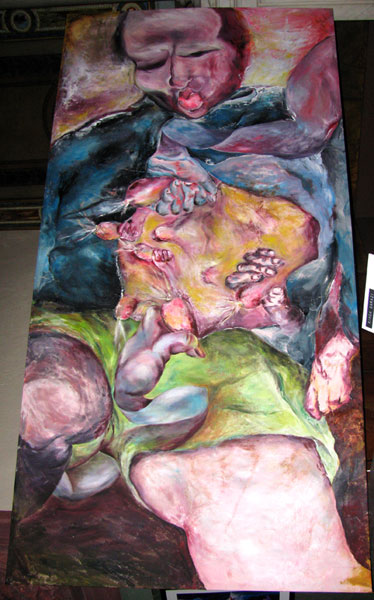
Eight artists participated in the first Openings show in 2007, a figure that is up to 15 in this third exhibit. The artists meet every Tuesday evening, and discuss a topic of their choosing. The artists do not have to be Catholic to participate, and are not asked their religious background unless they choose to share it.
“People say ‘You are reaching people who would never otherwise darken the doorway of a church,’” Father Sabatte said. “It’s real door-to-door evangelization and getting in a conversation with these folks. But that isn’t even the point. You converse with them and listen to them and help them see they are already connected to the spiritual through their art. Whatever happens next is a result of that.”
The ministry is also a vehicle of inspiration, reflection and respite for artists like Araceli Cruz, who moved to New York from California two years ago to pursue her art.
“It brings clarity to my art,” she said. “I get a sense of what kind of artwork is important me through our discussions and how to organize my thoughts.”
Ms. Cruz describes the weekly discussion group as intimate, with topics ranging from struggling with money to the competition between artists.
“It helps you understand you are not alone, that other artists are struggling with the same thing,” she said. “The conversation starts on the chosen topic, but always evolves into something deeper.”
Father Sabatte, who find the artists by visiting showings and masters-level art programs in Manhattan and its surrounds, said many young artists feel “they have had fingers wagged at them” and are suspect of institutionalized religion.
“Openings throws a monkey wrench in that thought process because now the institutional church is inviting them in,” Father Sabatte said.
 |
 |
 |
 |
 |
 |