April 24, 2015
The following is a homily based on the Scripture readings for Sunday, April 26.
With all the discussion about police around the country, let me give you two contrasting images. One, from the summer, in Ferguson, MO, where the death of an 18 year old sparked riots which went on for weeks, and could erupt again at any time. The other from 2001 when dozens of policemen and hundreds of firemen walked up dozens of floors of stairs looking to save people in a building that would collapse a short time later.
The difference between these images is, of course, the way these situations make us feel. One makes us feel uncertain, particularly in terms of the Justice Department’s study of attitudes in Missouri. Were the police really there to care for the people, and care for them entirely, or had some other motives somehow snuck in? In the case of the World Trade Center, we see the willingness of people to give their lives, to walk into danger, and to do so to the point of death.
Of course, people can throw cold water on any of us. We all have from now and then less-than-selfless attitudes. We all want to look out for ourselves, make sure we are getting what we think we deserve, and perhaps a little extra now and then. But we cannot throw cold water on the Lord Jesus, because who he was, and what he did, and why he did it, leaves no room for ambiguity.
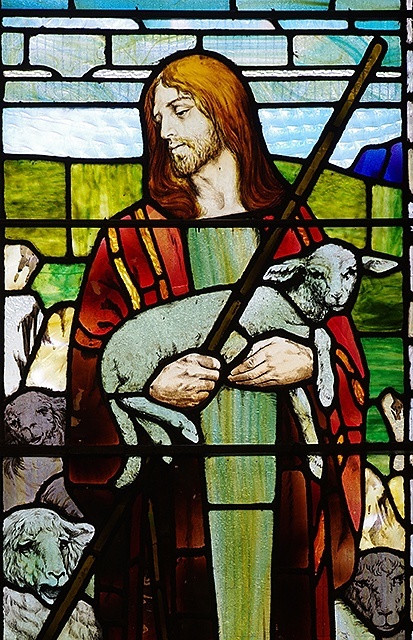
We have the image of the Good Shepherd today; every Easter season gives us an opportunity to think of Jesus as the Shepherd. Jesus contrasts himself with mercenaries, with hired people who are only in it for the pay. That motive, Jesus implies, is not enough, not when it comes to saving people and bringing them to the fullness of life. Others may seem to lead and protect us, but Jesus is the real deal. Jesus gives himself completely out of sheer love. He never runs away.
Jesus can do this because, now risen from the dead, he has faced every danger and ever evil we can face: he has penetrated the wall that has kept humans in fear, the wall of death. Now, overcoming death, he can be with us and for us forever. And he can lead us where he went, through all our fears, even our deepest fears, because he is always there for us.
We see Jesus’ followers acting as shepherds too; Peter and John giving away without any gain on their part healing to the crippled man. Jesus is the shepherd who asks his follows to be shepherds too – to look to the weaker, the poorer, the less certain, the more limited – and bring what help and healing we can. We call the leaders of our parishes pastors – shepherds – because their role is to live selflessly for others. But their pastoring should flow onto all of us. Easter means that the Holy Spirit takes the qualities of Jesus and pours them into our hearts, making us like the Risen Christ.
Perhaps we don’t like the idea of being sheep, so John gives us another image in the second reading. We are God’s children, slowly being transformed into the image of Jesus. As we see God more in Jesus, and as we receive Jesus’ love more as disciples, his image grows more and more in us. We are children, becoming more and more like the Son, being transformed the more we behold our God.
At our house last week we were talking about goats, and I asked how did goat sounds differ from sheep sounds. Some of our rural students did an imitation, long low baahs … shorter, higher baahs … But they said the real difference was that goats were smarter, more social, cleaner. Sheep, they said, were dumb, stubborn and smelly. Maybe we are like sheep, pretty stubborn and often dumb. But that only makes it more remarkable that the Shepherd loves us as he does.