October 8, 2025
Every four years, the Paulist Fathers undertake a process of discernment and prayer in anticipation of our missionary society’s quadrennial General Assembly. A step in this process are our Pre-Assembly gatherings with Paulist Fathers, Paulist Associates, Paulist Deacon Affiliates, and some of our lay collaborators.
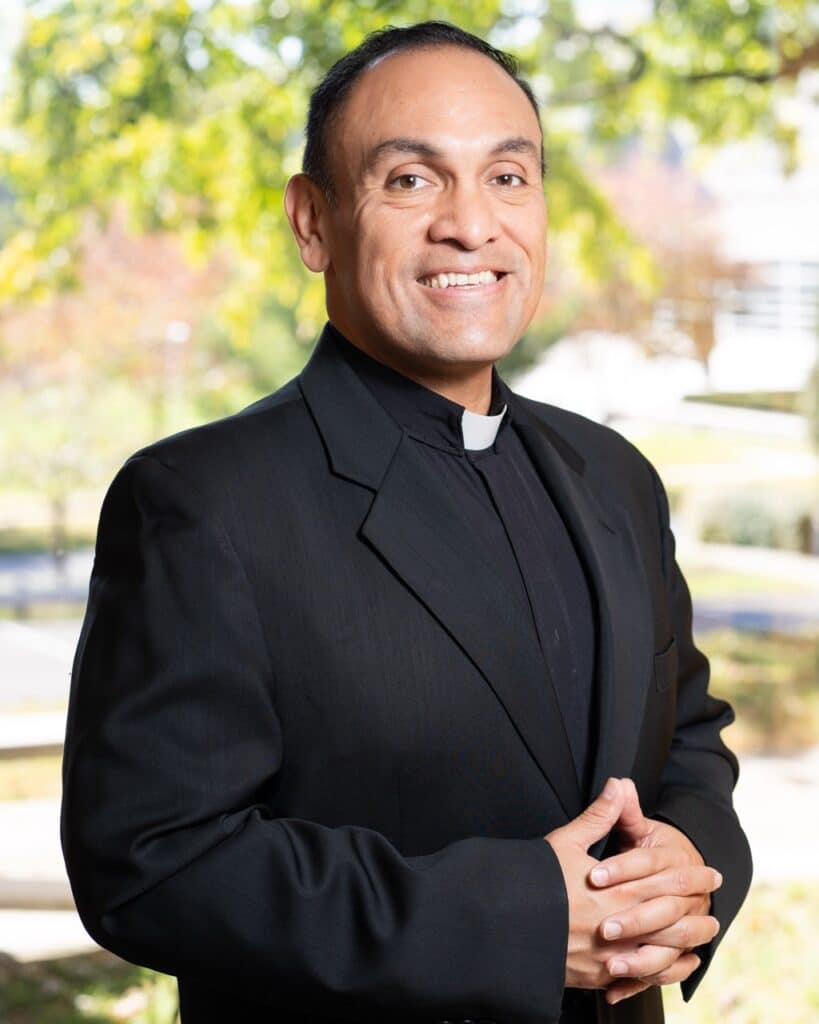
Paulist Fr. René Constanza, president of the Paulist Fathers, shared this homily at the Closing Mass of the East Coast Pre-Assembly held Oct. 6 to 8 in Huntington, NY.
 Sisters and brothers, today we hear the concluding part of the Book of Jonah. We see a reluctant prophet who bristled at God’s mercy. Jonah preached to Nineveh with little heart, and when the people repented, he grew angry that God did not destroy them. Jonah preferred vengeance over forgiveness, judgment over compassion, law over mercy. But God’s final word to Jonah is striking: “Should I not be concerned for Nineveh, that great city, in which there are more than 120,000 persons?” (Jonah 4:11).
This is a reminder that God’s heart always leans toward life, toward mercy, toward an embrace wider than our own. It is also reminder that prophets too must scrutinize their own hearts to get rid of barriers that impede the realization of God’s will.
As Paulists, this lesson reaches deep into our identity. Our Paulist Constitution, specifically the description of our Nature and Purpose, reminds us that we were founded by Servant of God Isaac Hecker to be a “dwelling place for the Holy Spirit and a prophetic instrument” (C2). We are called to be community, servant, and witness—bringing the Good News not only to believers, but especially to those outside the fold, those who have yet to experience the embrace of God’s mercy.
Yet we live in a moment of our American history when the Gospel is often co-opted—its radical message of love and mercy reduced to a tool of exclusion or division. Many voices proclaim Christianity while lifting law above compassion, rules above relationship, judgment above the tenderness of God. We know this distortion well; it wounds the Body of Christ and drives many away from church.
Our task, then, is nothing less than reclaiming the Gospel. The Paulist vocation has always been to “interpret the Church to the modern world and the modern world to the Church” (C4).
That requires us to speak and act with clarity: to make love credible again, to embody mercy in a world hardened by anger, to model compassion when so many choose condemnation.
What does this mean for us? First, it means renewing our own hearts. We cannot give what we do not have. Like Jonah, we may sometimes resist God’s wideness of mercy. We too must allow the Spirit to enlarge our vision, to soften our judgments, to deepen our compassion.
Second, it means courage in our ministries. The Paulist charism has always been missionary, ecumenical, dialogical. Whether through media, parish life, campus ministry, or public witness, we must resist fueling division and instead be instruments of unity and bridge-building. Our preaching, teaching, and presence must show a face of the Church that listens as well as speaks, that heals instead of wounds, that welcomes all into God’s household.
Finally, it means fidelity to our founder’s vision: presenting the “same old truths in new forms, fresh new tone and air and spirit.” That freshness is not novelty for its own sake; it is the Spirit’s way of making the Gospel alive and persuasive in our time.
Sisters and brothers, we are here to give thanks to a merciful and gracious God who now invites us to the table of plenty, to the altar of love so that we can be nourished and strengthened in mission–to embody mercy where others cry for retribution; to be in Hecker’s words, “missionaries to the modern age.” Amen.