March 17, 2015
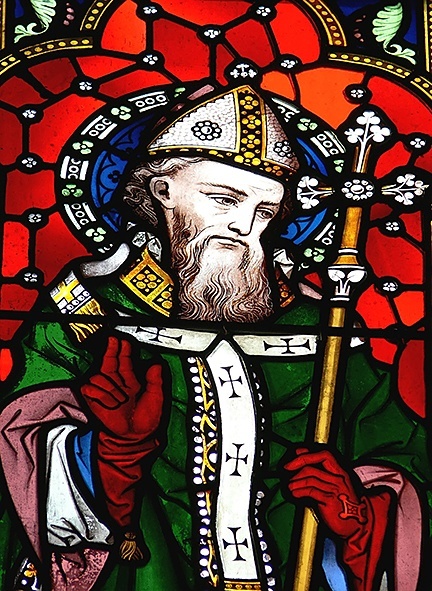
Patrick, the saint of the Emerald Isle, is often as misunderstood, as are the reasons for celebrating his feast. He was born in Scotland in the 5th century and was sold into slavery in Ireland, where he was a shepherd. Patrick escaped from slavery and returned to his native land. It was there, in prayer, that he found his vocation. God called him to be a missionary and bishop in Ireland. The richness of Patrick’s sanctity is based on the reality that he was a missionary. It is because he was a missionary that Patrick was chosen by the Paulist Fathers as one of the Paulist patrons.
What was the key to Patrick’s evangelization of Ireland? Many say that his gift to the Irish was to be sure that the virtues Patrick could find in the people – their love for the ‘mist,’ their awareness of the richness of the earth, their almost native instinct of faith in a living God – were virtues that Patrick nourished in leading the people whom he met (Druids all) to wish to be baptized and to follow Jesus. His evangelization insight, even in the 5th Century, led him to understand that the people of Ireland need not be stripped of what was important in their spiritual lives. The Celtic spirit does not want to be tied down. The ‘mist’ which is so prevalent in Celtic spirituality is like a sacrament – an outward sign of an inner grace. When you are aware of the ‘mist,’ you are aware of the Druids, the saints, the shamans and Christ. Patrick trusted that inner awareness of the Irish. He adapted the Catholic Christian faith to the faith the people already had, and they came in droves to listen to and follow Patrick, the bishop of Armagh, who was preaching the good news of Jesus.
Patrick himself tells us that he “baptized thousands of people.” Many historians will note that prior to his death, Patrick had converted nearly the entire population of Ireland, and the Irish people’s adherence to that faith has been deeply entrenched well into the 20th century. Today, Ireland is like many European countries and the United States. Secularism has taken hold and the “Irish ways of faith” seem to have faltered among the current generation of Irish men and women.
There are many myths about St. Patrick. It is said that he introduced the shamrock to explain the Trinity to the people who would gather around to hear him preach. He might well have. The shamrock has three green leaves on a single stem, and the shamrock might well explain – if it can be explained – what the union of Father, Son and Holy Spirit is about: three persons, one God.
It was also said that Patrick drove the snakes out of Ireland. When you navigate the roads of Ireland, peer into its golden sunsets or try to measure its frequent rainbows, you do notice that there are no snakes in the fields or slithering about along the roads. But since Ireland is an island it is likely that snakes were never part of its natural ecology.
Some Irish legends involve Copóg Phádraig (Patrick’s leaf) The legend has it that as he was evangelizing, Patrick carried an ash wood walking stick. When he was preaching he would push his stick into the ground wherever he was evangelizing. The myth goes on that Patrick preached so long and that the truths he was teaching took such a long time to accept that the staff took root where it was becoming a leaf bearing plant or tree.
It is difficult to determine the validity of any of these myths. But there is no difficulty at all establishing that St. Patrick was a determined and successful evangelizer and missionary. His gift to the Irish – and to us – is that he hallowed the lives of those whom he met in Ireland, not forcing them to become like him, a dedicated Anglo-Roman Christian, but instead helping them to accept Christ into their lives, lives rich in the love of the spirit and the God whose spirit they believed was all around them.