April 20, 2009
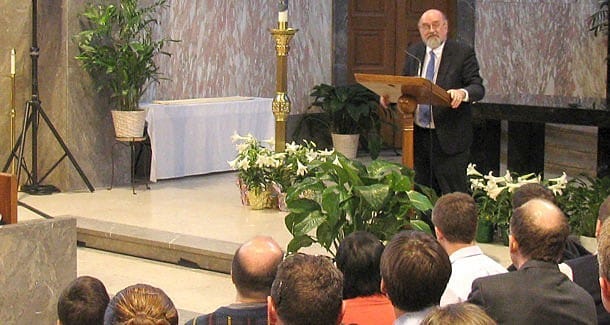 Father Robert Schreiter, C.PP.S., Ph.D, addresses an audience at the Reconciliation: Theological, Pastoral and Psychological Dimensions symposium
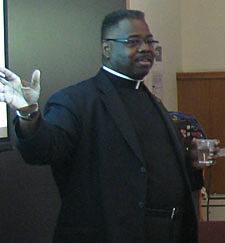 Father Clarence Williams, C.PP.S.
Reconciliation is urgently needed in mostly every level of human existence, but how to go about it?
Paulist Reconciliation Ministries and the Boston College School of Theology and Ministry teamed up to present “Reconciliation: Theological, Pastoral and Psychological Dimensions” April 17-18. More than 150 people attended the symposium held at Boston College.
The need for reconciliation has been the biggest topic in the church for the past five years, said Father Thomas A. Kane, director of Paulist Reconciliation Ministries and a professor at the Boston College School of Theology and Ministry.
“Millions of Catholics, many of them young adults, do not practice their faith,” he said. “The church in the United States has also experienced a major crisis of moral authority through the scandal of abusive clergy. … The divisions within the church seem to grow wider every day, with extremes on all sides dismissing large numbers of their Catholic brothers and sisters as somehow less than truly Catholic. Gender and sexual issues, perhaps revealed best in the areas concerning abortion and homosexuality, are not easily pastorally addressed. It might well be claimed that the church has gotten out of touch with the culture around it, as the impulse toward secularity drives popular culture into forms and laws which seem ever more distant from some church teachings.”
The use, or disuse, of the sacrament of Reconciliation can be held as a symbol of the disarray found in today’s church, Father Kane said.
“The sacrament, rather than being a point of ready access, appears to many as a roadblock,” he said.
Father Robert Schreiter, C.PP.S., Ph.D, a professor at the Catholic Theological Union in Chicago and author of The Ministry of Reconciliation, posed two questions: Where are we on the road to reconciliation and, when considering reconciliation, are we looking to the past or building a future? [Read full text here]
“The learning curve has been steep in many ways over the past 20 years,” said Father Schreiter. “When we engage in reconciliation, it makes a new creation, utterly transformed.”
Responding to the second question, Father Schreiter said; “In a road that is as much marked by paradox as another other trope, the answer is: yes. Both are essential dimensions. To be sure, depending upon the terrain that needs to be traversed, there may be more emphasis on one than the other. For the generation that has experienced acute loss and trauma, the past may be pre-eminent. For their children and grandchildren, the future may be the preoccupation. In the next presentation, I will turn to these questions in more detail, and look at how a community of reconciliation must be such that it is at once a community of memory and a community of hope. The nature of wounds that wrongdoing wreaks upon the human heart and the human community, no single dimension will suffice for the healing. Healing is something that must embrace all of the dimensions of the human condition and the human journey.”
 Sister Katherine Dooley, O.P.
Sister Katherine Dooley, O.P., associate professor in the School of Theology and Religious Studies at the Catholic University of America, shared her expertise in religious education with regard to ritual and reconciliation.
“The sacrament of Reconciliation is an act of worship,” said Sister Katherine, author of To Listen and Tell: Commentary on the Introduction to the Lectionary for Masses with Children and editor of The Echo Within: Emerging Issues in Religious Education. “When we ritualize reconciliation, we reconcile our lives. The work of reconciliation is not just for priests; the work of reconciliation is the work of everyone.”
Each symposium participant also chose two breakout sessions, with topics such as: Ritual and Reconciliation; So They may be One: A Catholic Common Ground Dialogue for Church Groups; Toward S-O-B-E-R Race Relations; Laity and Reconciliation: A Question of Restoring Trust; Expanding the Ritual Forms of Reconciliation and Forgiveness; Reconciliation within the Churches; What Does the Bible say about Reconciliation?; Seeing the Image of God in Others; and Reconciliation from a Protestant Perspective.
The symposium concluded with a reconciliation service at the Paulist Center in downtown Boston.
“There are so many people, particularly young people, that feel hurt and alienated from the church in our community,” said Annye Hughes of St. Augustine Church in Memphis. “We know who they are; we know where they are. We need patience and love. With the help of the Holy Spirit, we will build this [reconciliation] ministry and they will be reconciled with the church.”