March 6, 2015
The following is a homily based on the Scripture readings for Sunday, March 8.
Weed is coming to Washington. Not that it hasn’t been there for decades already. But the City Council legalized it in response to the results of a recently held popular vote. It’s hard to know what this means. There are many restrictions. Much of the vote surely had to do with the disproportionate arrest of young minorities on drug charges. Yet I certainly saw pot as an entry drug for a generation of children in the ’80s. But now it’s legal. Perhaps this is saying that, in some cases, there’s only so much law can do.
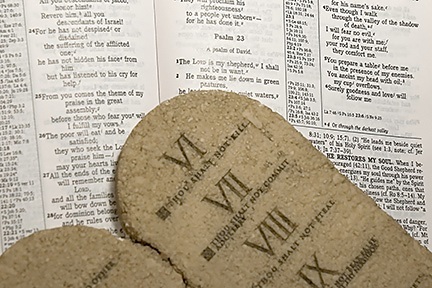
We have very paradoxical readings today. In the first reading, Moses proclaims the Ten Commandments as God’s law, the foundation of Jewish behavior and of much moral and legal thinking in our Western culture. On the other hand, we see Jesus purging the Temple, acting in a bold and undermining way when he drives merchants from the Temple area. He certainly looks like an outlaw to the leaders of his day. Yet what he does points to what law and commandment was always about.
We traditionally divide the commandments into two parts, the first ones being about our relationship with God, and the remaining commandments being about our relationship with others. But all the commandments are about integrity – the way we can stand simply and openly before God, acknowledging God as the center and source of our lives, and the way, as a result, we behave differently toward each other. Integrity with God involves integrity with others; lack of integrity with others means something is missing in my relationship with God.
We know the first reaction to a law is to want to break it. Stay away from those cookies! Sure. When someone sends a gift and tells us not to open it until our birthday, it drives us crazy. When the speed limit is 55, we need to add 10 miles to it. And no matter how much we legislate against some things, a percentage of the population tends not to follow. So law is either in our hearts or it is not. Our integrity has to come from within, no matter what the outside says. Our relationships with God and others have to be part of our very consciousness.
The Gospel shows us how even religion can be a way to obscure our relationship with God. And we certainly know we can go through the exterior motions of our faith while our hearts are far away. We have our rosaries or medals, but it doesn’t stop us from contradicting our faith by the way we behave. I have to wonder what St. Christopher is thinking as he listens to me comment on other drivers on the highway! Jesus is telling people that they have get beyond the externals of their temple and its practices to the inner reality that he is – God’s living temple in our midst and in our hearts. Paul remarks on how the desire for signs or for proofs kept people in his day from seeing Jesus as he is: God’s revelation come to us, God’s wisdom and power, made real.
The invitation of Lent, that we be converted, suggests not that we throw away all the forms of our faith, but that we get behind them, unpack them, and experience our relationship with God anew. How do we have integrity before God? Not on our own, but only in Christ Jesus. Only by being one with him, making his life our life, and his heart the motive from which we live. Jesus knows what’s in our hearts; he needs no one to give him insight into human nature. But knowing what’s in our hearts, he gives himself nonetheless, to transform those hearts to be like his through his Holy Spirit.
Each Sunday in Lent we’ve seen deeper dimensions of God’s covenant with us – Noah, then Abraham and today Moses. But all of this is to point to the ultimate covenant God makes with us—the gift of his Son who, in turn, can make us a gift to God as we pray so often at Mass. If we want to be converted, we know what it involves: saying “yes” to Jesus as the center of our souls, the power from whom all our other actions radiate.
When we hear of commandments, and of laws, it can lead us to think everything depends on us and our moral rigor. But when we have finally met Christ we know that everything depends on us letting him place his Spirit in our hearts. Let’s make sure we meet him in our worship today.